

Key Takeaways
Impulse Buying
Impulse buying is the act of making an unplanned purchase driven by an immediate emotional or psychological reaction rather than deliberate need. It happens when a stimulus-a display, a price tag, or a sense of urgency-triggers a desire strong enough to override a shopper's original intentions. It is extremely common and not a sign of personal weakness; it is, in large part, a designed response.
Behavioral economists describe impulse buying as a failure of System 2 (slow, deliberate reasoning) to override System 1 (fast, instinctive reaction)-a framework popularized by psychologist Daniel Kahneman.
How Retail Environments Are Designed to Trigger Spending
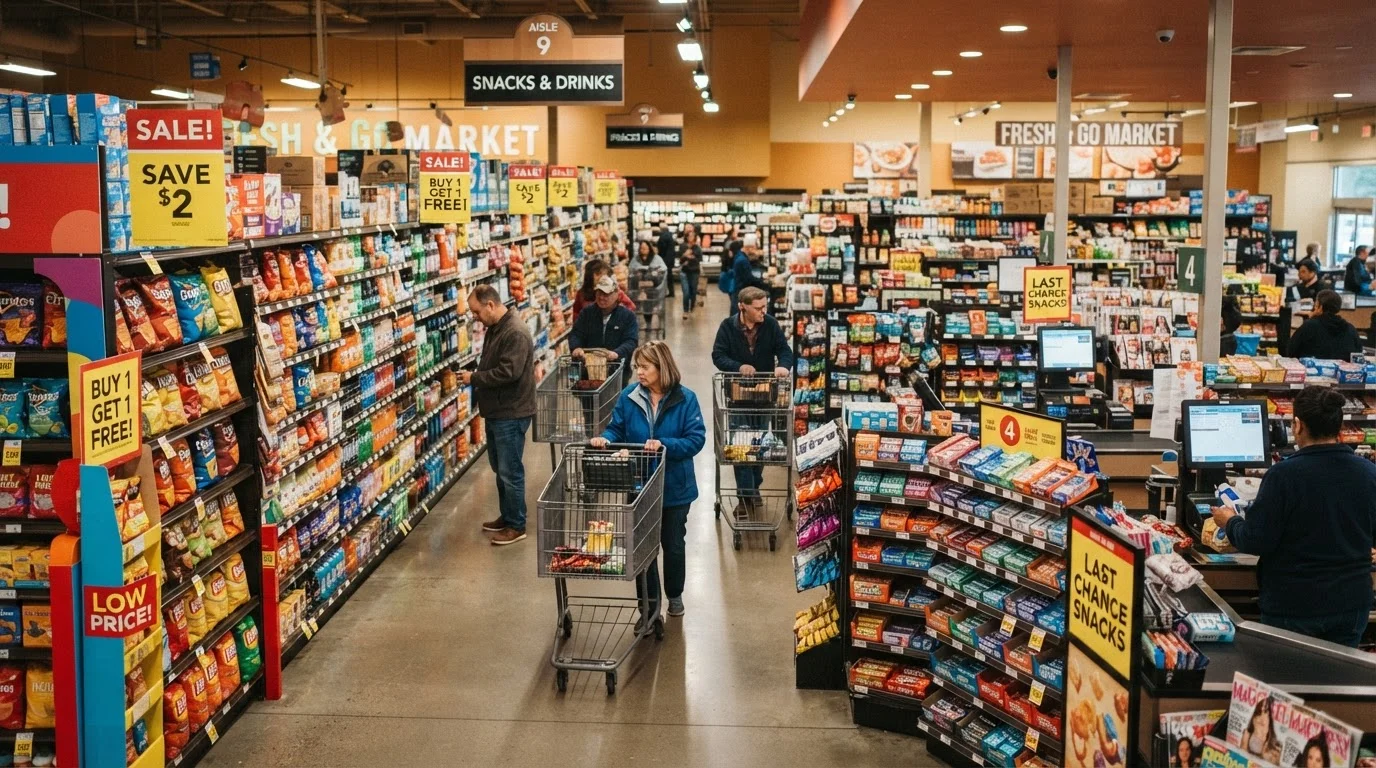
Walk into any large grocery or general merchandise store and you are moving through a space that has been deliberately planned, often down to the placement of individual product categories. Essential staples-milk, bread, eggs-are typically located at the back or perimeter, requiring you to pass a gauntlet of non-essentials first. End-cap displays (the shelves at the end of each aisle) are premium real estate specifically reserved for products retailers want you to notice without seeking them out.
Checkout lanes are arguably the most studied example of engineered temptation. Small, low-cost items-candy, batteries, magazines-are placed where shoppers stand idle, lowering the mental barrier to adding 'just one more thing.' Price anchoring is equally deliberate: a product displayed next to a much more expensive alternative feels like a reasonable choice by comparison, even if you had no prior intention of buying either.
Physical store design extends to lighting, scent, and music tempo. Research in consumer behavior has long documented that slower music correlates with longer shopping durations, and pleasant ambient scents can elevate mood in ways that loosen spending inhibitions. None of this is accidental. Understanding how retail discounts are structured is one useful lens-but the environment shaping your decisions before you even reach a price tag is equally worth examining.
The Psychological Mechanisms Retailers Exploit
Several well-documented cognitive biases make shoppers reliably susceptible to unplanned spending, and retailers have refined their ability to activate them.
~$150
Average monthly U.S. impulse spending per consumer
Survey data from Slickdeals (2019) found Americans reported spending roughly $150 per month on impulse purchases, though self-reported figures likely undercount actual behavior.
40%
Share of e-commerce revenue from unplanned purchases
Industry estimates have placed impulse buying at approximately 40% of all e-commerce spending, reflecting how effectively digital platforms engineer spontaneous decisions.
Loss aversion is among the most powerful. People consistently respond more strongly to the prospect of losing something than gaining an equivalent benefit. 'Only 3 left in stock' or a countdown timer on a website doesn't communicate value-it communicates potential loss, which triggers urgency that bypasses careful deliberation.
Social proof works similarly. Seeing that a product has thousands of positive reviews, or that it is labeled 'bestseller,' signals that others have already validated the choice-reducing the cognitive effort required to decide and making the purchase feel safer than it may actually be.
The decoy effect is subtler but equally effective. When a third, clearly inferior option is added to a two-item comparison, it makes one of the original options look significantly more attractive by contrast. This is why you'll often see three pricing tiers where the middle option appears to be the obvious 'smart' choice.
Emotional state plays a significant moderating role in all of this. Stress, boredom, and excitement each independently increase vulnerability to impulse purchases-a dynamic sometimes called 'retail therapy.' This is not a character flaw; it reflects how human emotional regulation actually works. Spending patterns that quietly drain household budgets often have roots in these exact emotional triggers operating repeatedly over time.
“The gap between stimulus and response is where our rationality lives-but retailers work hard to close that gap as much as possible.”
— Paco Underhill, Consumer behavior researcher and author of 'Why We Buy'
How Digital Retail Amplifies These Tactics
E-commerce platforms have adopted every technique from physical retail and added several of their own. One-click purchasing removes friction-the small pause of entering payment details-that previously gave shoppers a moment to reconsider. Personalized recommendations powered by purchase history and browsing behavior serve up products calibrated to each individual's demonstrated preferences, making the 'just browsing' experience feel curated and appealing.
Countdown timers, flash sales, and 'X people are viewing this right now' notifications are digital analogs of in-store scarcity cues, engineered to invoke the same loss-aversion response. Notification badges and email subject lines like 'You left something behind' (cart-abandonment emails) re-engage shoppers who already resisted once.
The infinite scroll format used by many shopping apps is borrowed from social media design, where it is specifically intended to eliminate natural stopping points. Without a clear 'end,' browsing continues longer and the opportunity for impulse selections multiplies. Shopping smarter as a general habit requires accounting for digital environments just as much as physical ones.
Practical Strategies for Spending More Intentionally
Awareness of these mechanisms is genuinely useful-behavioral research suggests that simply understanding a persuasion tactic reduces its effectiveness, though it does not eliminate it entirely. Several practical habits reinforce that awareness.
The 24-Hour Rule for Non-Essential Purchases
Before completing any unplanned purchase that is not immediately necessary, add it to a wishlist or note and wait 24 hours. This simple delay gives your deliberative reasoning time to assess whether the item genuinely fits your needs and budget-or whether the initial pull was purely situational. Many shoppers find that the desire fades significantly overnight.
Use a list as a commitment device. Writing down what you intend to buy before shopping-whether in a store or online-converts an intention into a mild form of self-imposed accountability. Departing from the list becomes a visible, conscious decision rather than an automatic one. Our pre-purchase checklist for everyday buys offers a structured set of questions to ask before adding any non-essential item to your cart.
Introduce deliberate friction. Removing stored credit card details from browsers, unsubscribing from promotional email lists, and turning off push notifications from shopping apps all add small delays that allow more considered decisions. The goal is not inconvenience for its own sake, but restoring the brief pause that designed frictionlessness removes.
Shop on a full stomach and in a neutral emotional state where possible. This is not about willpower-it reflects the genuine influence emotional and physical states have on financial decision-making.
Finally, treat occasional impulse purchases without shame. The aim of consumer awareness is informed choice, not perfect spending. If you occasionally buy something unplanned and you can comfortably afford it, that is a normal part of life. Building a workable personal budget gives you the visibility to make those judgment calls with confidence rather than anxiety.
And if you find that habitual unplanned buying is affecting your finances in ways that concern you, that is worth examining-ideally with a qualified financial adviser who can help you look at the full picture of your household spending.