

Key Takeaways
Basement Moisture Sources
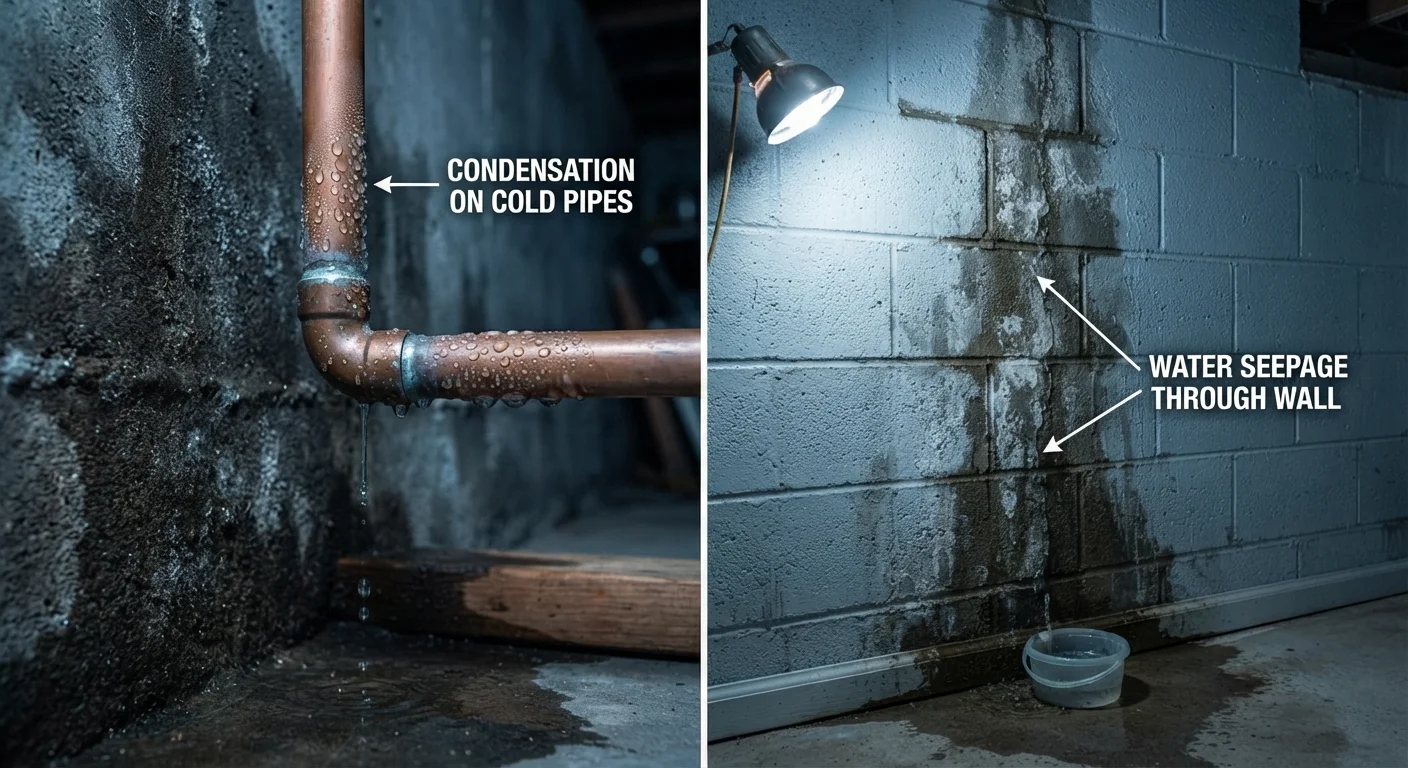
Basement moisture falls into two distinct categories: condensation, which forms when warm, humid air contacts cool surfaces inside your basement, and seepage, which is water that physically migrates through your foundation walls or floor from the surrounding soil. Knowing which type you have is essential before spending money on any repair, because the solutions are completely different.
Condensation is a function of relative humidity and dew point; seepage is driven by hydrostatic pressure - the force exerted by water-saturated soil pressing against foundation walls.
Why Identifying the Source Matters First
A damp basement is one of the most common homeowner concerns in the US - but treating it incorrectly can waste thousands of dollars. Waterproofing companies may recommend interior drainage systems or exterior excavation, while the real culprit might simply be humid summer air cooling against your concrete walls. Before any repair, your first job is diagnosis.
Both condensation and seepage produce wet walls, puddles, and musty smells. The key difference is where the moisture originates: inside the basement air, or from the soil outside the foundation.
Both Problems Can Occur Simultaneously
It's possible - and fairly common - to have both condensation and seepage in the same basement. Running the plastic sheet test in multiple locations, especially areas with different moisture patterns, will help you identify whether you're dealing with one problem, the other, or both at once. Address each source with its appropriate solution.
The Plastic Sheet Test: A Simple DIY Diagnostic
The most reliable low-cost diagnostic is the plastic sheet test. Cut a piece of heavy plastic sheeting (a section of a garbage bag works) roughly 12 inches square. Tape all four edges firmly to a damp wall using duct tape, creating an airtight seal. Leave it in place for 24 to 48 hours.
- Moisture on the outer face of the plastic (between plastic and room air) points to condensation - warm indoor air is cooling against the wall and depositing water vapor.
- Moisture behind the plastic (between plastic and wall) indicates seepage - water is migrating through the foundation material itself.
Run this test in more than one location if dampness appears in multiple spots. The pattern matters: seepage often concentrates near floor-wall joints, around pipe penetrations, or along visible cracks, while condensation tends to be more evenly distributed across colder surfaces.
Understanding Condensation: An Indoor Humidity Problem
Condensation occurs when warm, moisture-laden air comes into contact with surfaces that are cooler than the air's dew point - the temperature at which water vapor turns to liquid. Basement walls and uninsulated cold-water pipes are prime targets in summer months.
Common sources of excess indoor humidity feeding basement condensation include:
- Clothes dryers venting indoors or with leaky duct connections
- An attached garage or crawl space allowing humid air in
- Poor air circulation keeping the basement closed and stagnant
- Uninsulated cold-water pipes sweating in summer
The fix focuses on reducing humidity and warming surfaces. Running a dehumidifier to keep relative humidity below 60%, improving ventilation, insulating cold pipes, and sealing air leaks between floors are the primary strategies. For gaps and air infiltration issues elsewhere in your home, understanding when to use caulk versus weatherstripping can complement your moisture-control efforts.
Insulate Pipes to Stop Sweating
Foam pipe insulation sleeves are inexpensive and available at most hardware stores. Wrapping cold-water pipes prevents the cool surface from acting as a condensation point during humid months - a quick fix that eliminates one of the most common sources of basement dripping.
Understanding Seepage: An Exterior Water Problem
Seepage is water physically entering your basement from outside, driven by hydrostatic pressure - the weight of water-saturated soil pushing against your foundation. Concrete is porous by nature, and block foundations have mortar joints that can degrade over time, creating pathways for water.
Seepage is most apparent during or shortly after heavy rainfall, or during spring snowmelt. Signs that distinguish it from condensation include:
- White chalky deposits (efflorescence) on walls - mineral salts left behind as water evaporates after passing through concrete
- Visible cracks, especially at wall-floor joints or around pipe entry points
- Standing water that appears during rain events and dries between them
- Staining or discoloration tracking downward from specific points
Fixing seepage typically involves improving exterior drainage: regrading soil away from the foundation, cleaning gutters and extending downspouts, and addressing any cracks with appropriate masonry sealants or hydraulic cement. Persistent or severe seepage - particularly if walls are bowing or cracks are widening - warrants evaluation by a licensed structural engineer or waterproofing professional.
98%
Of basements experience moisture at some point
According to the American Society of Home Inspectors, nearly all basements will have some moisture issue over the life of the home.
60%
Relative humidity threshold for mold risk
The EPA notes that indoor humidity above 60% creates conditions favorable for mold growth, making humidity control a key preventive measure.
Keeping Moisture From Becoming a Bigger Problem
Whether you're dealing with condensation or seepage, both moisture types create conditions that support mold growth, degrade wood framing, and can affect indoor air quality throughout the home. Once you've identified and addressed the source, ongoing prevention is straightforward.
For condensation control, a programmable dehumidifier running during humid months is the most effective long-term tool. Checking that bathroom and kitchen exhaust fans vent completely outside - not into the attic or basement - also reduces moisture load. If you have wet areas in your home that border the basement ceiling, ensure seals are maintained: grout and caulk in wet areas are often overlooked contributors to whole-home moisture problems.
For seepage prevention, annual gutter cleaning, maintaining positive slope away from the foundation, and checking window well drainage are low-cost habits that reduce water pressure against your walls over time.
This article is for general informational purposes only and does not constitute professional engineering, waterproofing, or construction advice. For persistent or structural moisture issues, consult a licensed professional and verify any permits or code requirements with your local authority.