

Key Takeaways
Option A
Caulk
The permanent, flexible sealant for stationary gaps.
Best for: Sealing fixed gaps and cracks around window frames, door casings, baseboards, and other non-moving surfaces where air leaks in.
Option B
Weatherstripping
The compressible, replaceable seal for moving parts.
Best for: Sealing the moving edges of doors and operable windows where surfaces must open and close repeatedly without breaking the seal.
If you're sealing a fixed crack between a window frame and exterior siding
Caulk
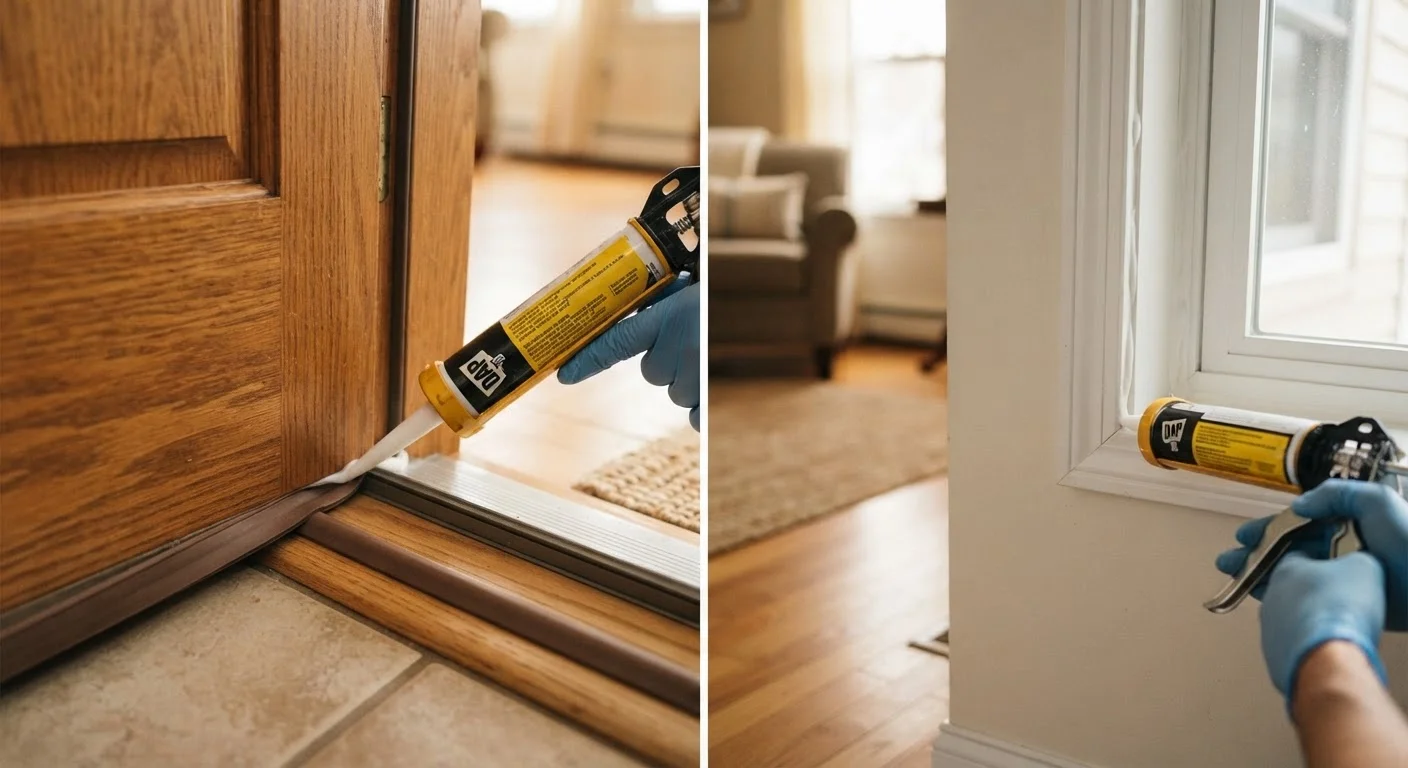
Stationary gaps need a permanent, bonded seal. Caulk fills and bonds to both surfaces, blocking airflow without restricting any movement.
If you're stopping drafts along the edges of a frequently used exterior door
Weatherstripping
Door edges open and close dozens of times a day. Weatherstripping compresses and rebounds with that motion without cracking or detaching.
If you're working around the perimeter of an operable casement or double-hung window
Weatherstripping
The sash moves when the window opens, so a flexible, compressible seal is needed rather than a rigid bonded material like caulk.
If you want to address both drafts and moisture intrusion around a door frame
Caulk
Apply caulk to the fixed joint between the door casing and the wall - then use weatherstripping on the door's moving edges. Both materials together provide full coverage.
Why the Distinction Matters
Air leaks account for a significant share of energy loss in a typical American home. The U.S. Department of Energy notes that gaps, cracks, and openings in a home's envelope - the barrier between conditioned interior air and the outdoors - are a primary pathway for that loss. Two materials dominate the DIY solution: caulk and weatherstripping. They're often sold in the same aisle, but they are not interchangeable.
The core difference comes down to motion. Caulk is a sealant that bonds to two fixed surfaces and cures into a flexible but stationary bead. Weatherstripping is a compressible material that forms a seal when a moving part - a door or window sash - presses against it, then springs back when that part opens.
Applying caulk where weatherstripping belongs - say, along the latch side of an exterior door - means it will crack and separate every time the door opens. Applying weatherstripping foam tape across a fixed gap in siding means it never compresses properly and leaves air pathways around its edges. Knowing which to reach for first saves time, money, and frustration. For related moisture-sealing context in wet interior spaces, see how grout and caulk work in bathrooms and kitchens.
| Criterion | Caulk | Weatherstripping |
|---|---|---|
| Best application | Fixed, stationary gaps and cracks | Moving joints on doors and operable windows |
| Bond type | Adheres permanently to both surfaces | Compresses and rebounds; not bonded to moving part |
| Common materials | Silicone, acrylic latex, polyurethane | Foam tape, V-strip, rubber compression, door sweep |
| Typical lifespan | 5-10+ years (exterior grade) | 1-10 years depending on type and traffic |
| DIY difficulty | Low - caulk gun and steady hand required | Low to moderate - cutting and fitting required |
| Failure mode if misused | Cracks and separates if applied to moving parts | Never seats correctly on a fixed, non-compressing gap |
| Cost range | Generally a few dollars per tube | Varies by type; foam tape least, metal V-strip more |
Where to Use Caulk
Caulk belongs anywhere two stationary surfaces meet and leave a gap. Common locations in a home include:
- Around window and door frames - the joint between the frame or casing and the exterior wall or interior drywall
- At baseboards and crown molding - where trim meets the wall and small gaps allow conditioned air to escape into wall cavities
- Around pipe and wire penetrations - wherever plumbing or electrical work passes through an exterior wall or floor plate
- Along the sill plate - the horizontal lumber that sits on top of the foundation, a common source of basement drafts
For exterior applications, look for a paintable, exterior-grade siliconized acrylic caulk or a 100% silicone product, both of which handle outdoor temperature swings without becoming brittle. Interior gaps - around baseboards, for instance - are well served by standard acrylic latex caulk, which is easy to tool and paint.
25-30%
Home heating/cooling energy lost through air leaks
The U.S. Department of Energy estimates that air leaks through gaps, cracks, and openings account for roughly 25-30% of heating and cooling energy use in a typical home.
$0-$50
Typical DIY cost for a full door air-seal
A complete door air-sealing project - caulk for the frame joints plus weatherstripping for the moving edges - is generally achievable for most households at low material cost.
Before applying, clean and dry the surface and remove any old, crumbling caulk. Apply in temperatures above 45°F when possible, and allow at least 24 hours for a full cure before painting over it. If you're also managing moisture concerns in lower levels of your home, understanding basement moisture sources can help you address related gaps at the foundation level.
Where to Use Weatherstripping
Weatherstripping is designed for the moving joints of doors and operable windows - places where a rigid, bonded material like caulk would fail quickly. The most common applications include:
- The top and sides (door stop) of exterior door frames - foam tape, V-strip (tension seal), or compression strips all work here depending on the gap size
- The bottom edge of exterior doors - door sweeps or automatic door bottoms seal the gap between the door and the threshold
- The sash channels of double-hung windows - V-strip or pile weatherstripping fits into the channel and seals as the sash slides
- The perimeter of casement windows - compression foam or rubber gaskets compress when the window closes
Foam tape is the most accessible option for light to moderate gaps, but it compresses permanently over time and typically needs replacement every one to three years. V-strip (a folded piece of metal or plastic installed into a channel) is more durable and suits doors and double-hung windows well. Door sweeps, installed along the bottom interior edge of the door, address one of the largest single sources of draft in most homes.
Check the Gap Size Before You Buy
Not all weatherstripping compresses the same amount. Foam tape works well for gaps up to about 1/4 inch, while larger or uneven gaps may require a more rigid compression strip or a combination approach. Measuring the gap with a feeler gauge or simply sliding a piece of paper through the closed door can help you gauge what thickness and type you need before purchasing material.
Using Both Together
In practice, most air-sealing projects on a door or window call for both materials working in tandem. Consider a standard exterior door: the door stop (the strip of trim the door closes against) needs weatherstripping along its face to create a compression seal. The fixed casing around that door frame - where the frame meets the exterior siding or interior drywall - needs caulk to close the static gap. Neither material alone covers every pathway.
A good inspection routine is to run your hand slowly around each exterior door and operable window on a cold or windy day, feeling for drafts. Where you feel air at the edges of a moving door or window sash, weatherstripping is the answer. Where you feel air along a fixed joint between two surfaces - a frame and a wall, for example - caulk is the answer. This distinction is straightforward once you've identified whether the gap is static or dynamic. Systematic home-envelope attention - including gutters that direct water away from the foundation - contributes to a tighter, lower-maintenance home; learn when gutters need cleaning, repair, or replacement as part of your maintenance routine.