

Key Takeaways
The 50/30/20 Rule
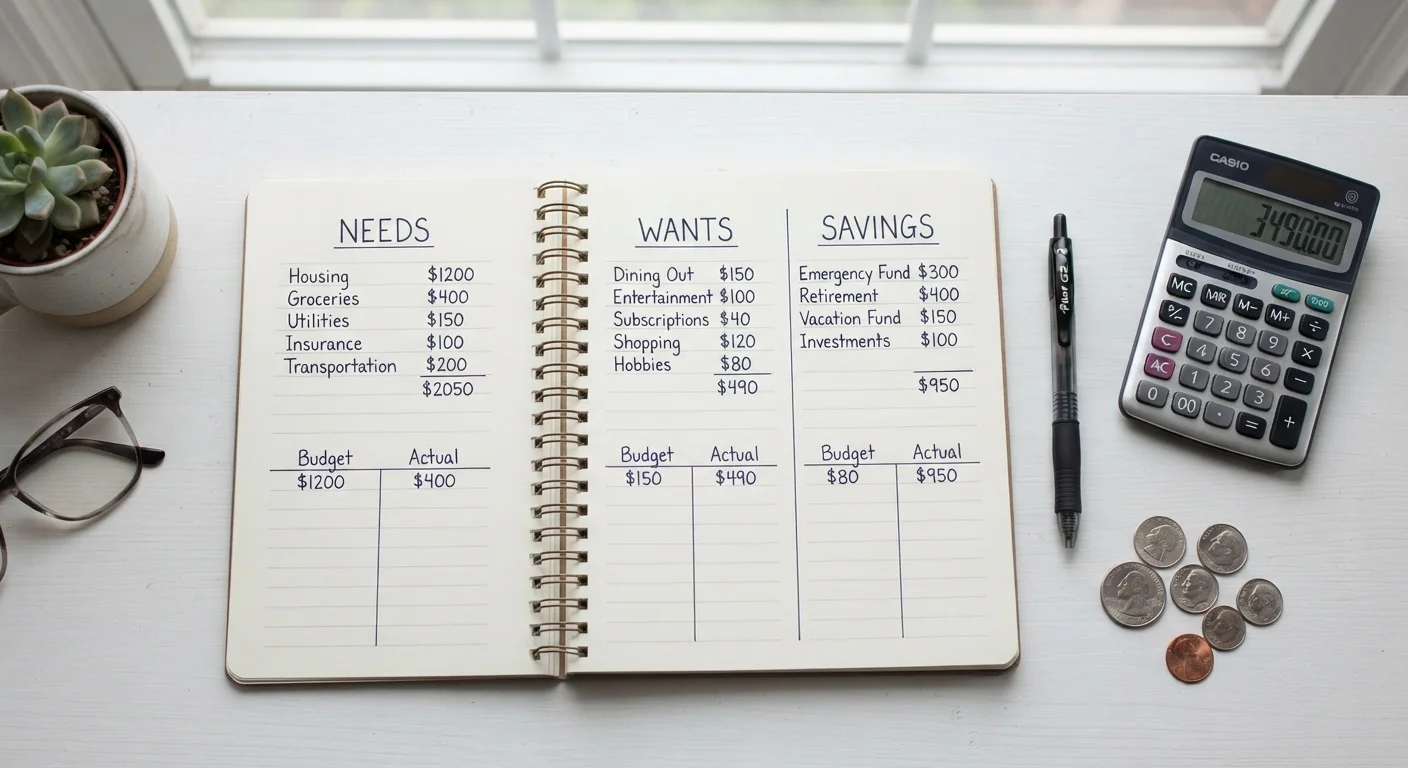
The 50/30/20 rule is a budgeting guideline that divides your after-tax income into three categories: 50% toward needs (essentials like rent and utilities), 30% toward wants (dining out, entertainment, hobbies), and 20% toward savings and debt repayment. It was popularized by U.S. Senator Elizabeth Warren and her daughter Amelia Warren Tyagi in their 2005 book, "All Your Worth." The framework is designed to give people a simple, memorable starting point for organizing their finances without tracking every dollar.
The "20%" category is sometimes described as covering both savings and debt repayment beyond minimum required payments. How you allocate within that 20% depends on your priorities, such as building an emergency fund versus paying down high-interest debt.
What the Three Categories Actually Mean
Understanding the 50/30/20 rule starts with getting clear on what each bucket actually covers - because the labels can be deceptively simple.
Needs (50%) are expenses you genuinely cannot avoid: rent or mortgage payments, utilities, groceries, health insurance premiums, minimum debt payments, and transportation costs required for work. The key test is whether cutting the expense would create a serious hardship.
Wants (30%) are discretionary spending choices - subscriptions, restaurant meals, gym memberships, vacations, and clothing beyond the basics. These are lifestyle expenses you choose, not obligations you owe. This is also where budgets get personal: one person's "want" (a gym membership) may feel like a mental health essential to another.
Savings and financial goals (20%) include contributions to emergency funds, retirement accounts, investment accounts, and extra debt payments beyond required minimums. This category is where long-term financial security is built. For a deeper look at structuring near- and far-term savings goals within this bucket, see organizing savings around short- and long-term goals.
Start with a Simple Spending Snapshot
Before applying any percentage framework, spend one month tracking your actual spending by category. Most people are surprised to find how their real allocation differs from where they think their money goes. A single month of honest data gives you a useful baseline to measure any framework against - and makes the first budget far more accurate.
Sorting expenses isn't always intuitive. Our companion piece on categorizing spending without overthinking it walks through the gray-area calls most people encounter.
Where the Framework Falls Short
The 50/30/20 rule's simplicity is both its greatest strength and its most significant limitation.
30%+
Share of income renters spend on housing
The U.S. Department of Housing and Urban Development defines households that spend more than 30% of income on housing as "cost-burdened" - a threshold many American renters exceed.
~57%
Americans living paycheck to paycheck
Multiple consumer surveys conducted in recent years, including research by LendingClub, have found that a majority of U.S. adults report spending most or all of their monthly income on expenses, leaving little margin for savings.
20%
Recommended savings and debt-payoff rate
The 50/30/20 framework's savings target aligns with longstanding general guidance from financial educators, though actual household savings rates in the U.S. vary widely depending on income level and economic conditions.
Housing costs are the biggest pressure point. In many U.S. metropolitan areas, rent alone can consume 40-50% of a median renter's take-home pay - before factoring in any other essential expense. When housing absorbs the entire needs allocation, there's no room for groceries, utilities, or transportation within the 50% ceiling.
Income level matters enormously. Lower-income earners typically spend a higher proportion of income on necessities, making the 50/30/20 split structurally difficult to achieve. The framework implicitly assumes a level of income where discretionary spending is genuinely possible - an assumption that doesn't hold for every household.
It doesn't address income variability. Freelancers, gig workers, and anyone with irregular income face challenges applying fixed percentages to paychecks that fluctuate month to month. A percentage-based approach works better in theory than in practice when the base number keeps changing.
None of these limitations mean the framework is useless - they mean it should be treated as a starting reference point rather than a prescription.
The Rule Is a Guide, Not a Grading System
Missing the 50/30/20 targets doesn't mean you're failing at budgeting. For many households - especially those in high-cost areas or on modest incomes - the standard percentages simply don't reflect structural realities. Think of the framework as a directional compass rather than a pass/fail test. Progress toward better allocation matters more than achieving textbook numbers.
Adapting the Rule to Your Real Life
The most effective version of the 50/30/20 rule is one you've customized. If your needs reliably consume 60% of your income, a 60/20/20 split is more honest than a framework you'll abandon because it doesn't reflect reality. Flexibility is a feature, not a flaw.
Consider these adjustments based on your circumstances:
- High housing costs: Temporarily compress the wants category while you build income or reduce fixed expenses. A 55/15/30 split can make sense if you're aggressively paying down debt.
- Significant debt load: Prioritize the 20% bucket for debt repayment first, then redirect those payments to savings once high-interest balances are cleared.
- Low starting savings rate: Even a 50/40/10 split represents progress. Automating that 10% through payroll deduction or automatic transfers removes the friction of remembering to save.
An alternative worth understanding is the pay-yourself-first principle, which reverses the order - setting aside savings before allocating anything else. This approach pairs naturally with the 50/30/20 framework and can help ensure the savings target isn't crowded out by spending.
Whatever percentages you land on, pairing them with a consistent monthly budget review is what turns a guideline into a working financial habit.
This article is for general informational and educational purposes only and does not constitute personalized financial, tax, or legal advice. Consult a qualified financial professional for guidance specific to your situation.