

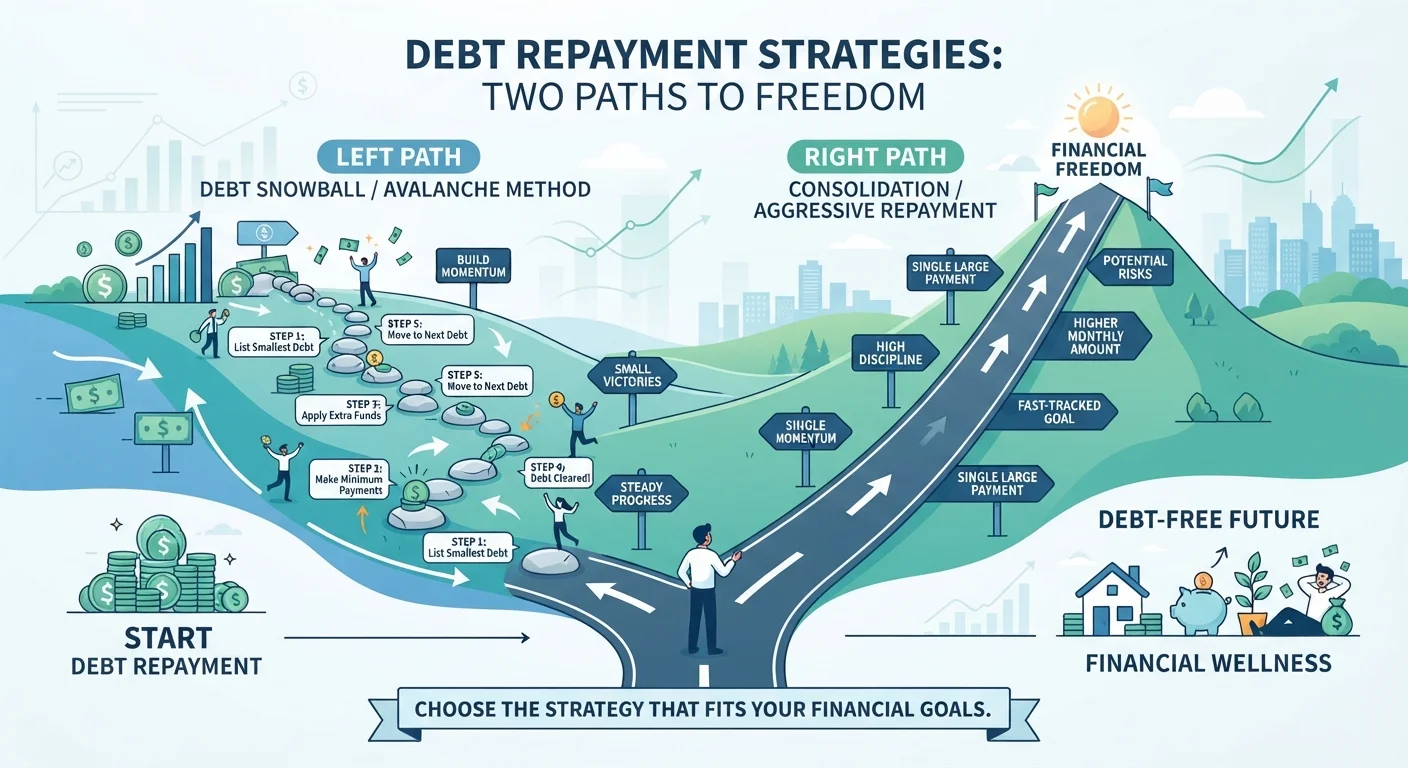
Key Takeaways
Option A
Debt Snowball
The motivation-first approach to debt payoff.
Best for: People who need frequent wins to stay on track and want to simplify their debt load quickly.
Option B
Debt Avalanche
The mathematically efficient route to debt freedom.
Best for: People who are disciplined, focused on minimizing total interest paid, and comfortable with delayed gratification.
If you struggle with motivation and need early wins
Debt Snowball
Paying off small balances quickly creates momentum and a sense of accomplishment that can keep you committed to the long-term plan.
If minimizing total interest paid is your top priority
Debt Avalanche
Targeting high-interest debt first reduces the amount interest compounds over time, typically resulting in meaningful savings.
If you have many small debts cluttering your budget
Debt Snowball
Eliminating accounts one by one reduces the number of payments you manage each month, simplifying your finances.
If you carry one or two large, high-rate balances
Debt Avalanche
When high-interest debt dominates your balance sheet, attacking it directly saves the most money over time.
If you're unsure which method suits your situation
Debt Snowball
Starting with the snowball is lower-risk psychologically; you can always switch to the avalanche once you've built the habit of paying extra each month.
How Each Strategy Works
Both the debt snowball and the debt avalanche share the same foundation: you make minimum payments on all your debts, then direct any extra money toward one target debt at a time. Where they diverge is in which debt gets that extra attention.
Debt Snowball: You list your debts from smallest balance to largest, regardless of interest rate. You attack the smallest balance first. Once it's paid off, you roll what you were paying on it - the full payment amount - into the next smallest debt. Your payment toward the priority debt grows like a rolling snowball.
Debt Avalanche: You list your debts from highest annual percentage rate (APR) to lowest. You direct extra payments to the highest-rate debt first. Once that balance is gone, the freed-up payment moves to the next highest rate. To understand why APR matters so much here, see our article on how debt grows over time.
In both cases, the total amount you pay each month stays the same - you're simply redirecting what had been going to a cleared account.
| Criterion | Debt Snowball | Debt Avalanche |
|---|---|---|
| Payoff Order | Smallest balance first | Highest interest rate first |
| Total Interest Paid | Typically higher | Typically lower |
| Speed of First Payoff | Often faster (small balance) | Slower if high-rate debt is large |
| Psychological Motivation | High - frequent wins | Lower - longer wait for payoff |
| Mathematical Efficiency | Lower | Higher |
| Complexity | Low - easy to understand | Low - requires knowing your APRs |
| Best Personality Fit | Motivation-driven individuals | Goal- and data-oriented individuals |
The Real Cost Difference: Interest Over Time
The core mathematical advantage of the avalanche is straightforward: interest compounds on outstanding balances. Every month a high-rate debt sits unpaid, it generates more interest. By eliminating high-APR balances first, you reduce the principal that interest calculates against, which shrinks your total debt burden faster in dollar terms.
The snowball, by contrast, may leave high-rate balances accruing interest longer. Depending on your specific debts, this can mean paying noticeably more in interest over the full repayment timeline. The gap between strategies varies widely based on the balances, rates, and extra payment amounts involved - there is no universal figure that applies to every situation.
~$1,000+
Potential interest savings with avalanche method
Illustrative estimates from consumer finance educators suggest high-rate debt holders can save hundreds to over a thousand dollars by prioritizing rate over balance size, though outcomes vary widely by individual situation.
3 in 5
Americans carrying credit card debt
Federal Reserve data consistently shows a majority of U.S. households carry revolving credit card debt at any given time, making repayment strategy a broadly relevant financial decision.
20%+
Average credit card APR in recent years
Federal Reserve consumer credit data has shown average credit card interest rates exceeding 20% APR in recent periods, underscoring why interest rate targeting can matter significantly.
That said, the "cheapest" strategy in pure math is only effective if you actually stick with it. A plan abandoned six months in costs far more than a slightly less optimal plan you follow for years. That's the psychological case for the snowball.
If you're newer to managing credit and want a broader foundation, the starter's overview of credit and debt covers the core concepts in plain language.
Psychology vs. Precision: Choosing What Fits You
Financial research suggests that behavioral factors - not just math - drive whether people successfully eliminate debt. The snowball method aligns with principles from behavioral economics: small, frequent rewards reinforce the habit of paying extra, reducing the risk of abandonment.
The avalanche appeals to people who are motivated by data. Watching a high-rate balance shrink can feel meaningful if you understand the interest savings it represents, even if the account stays open for longer.
When Neither Method Applies Cleanly
Some debts - such as federal student loans or medical bills - may carry lower rates or have income-driven repayment options that make aggressive early payoff less urgent than eliminating high-rate consumer debt. If you carry a mix of debt types, the payoff order may benefit from a more tailored analysis. A licensed financial adviser or nonprofit credit counselor can help you map a strategy across all your obligations.
There is no shame in choosing the snowball over the avalanche - or vice versa. The "best" strategy is the one you can realistically maintain given your income, budget discipline, and how you respond to setbacks. You may also find that a hybrid approach - tackling one small balance first for a quick win, then pivoting to the highest rate - works for your situation.
Once your debts are cleared, redirecting those same monthly payments toward savings and investments can build lasting financial security. Explore the Saving & Growing hub for approachable next steps, and consider budgeting basics to make sure your repayment plan fits your broader spending picture.
If you're weighing whether to consolidate debts into a single loan before choosing a payoff method, our article on debt consolidation explains the mechanics and tradeoffs involved.
This article is for general informational and educational purposes only and does not constitute personalised financial, tax, or legal advice. Consult a qualified, licensed financial adviser for guidance specific to your circumstances.