

Key Takeaways
Why Pet Food Labels Can Mislead Without Lying
Pet food packaging is designed to sell. Phrases like "real chicken," "wholesome grains," and "premium nutrition" are crafted to reassure buyers - but they often describe things the label doesn't actually have to prove. The result is that shoppers make decisions based on front-of-bag impressions rather than the regulatory panel on the back or side.
The good news: once you know what each section of a label is legally required to contain, you can separate meaningful information from marketing noise in under two minutes. This guide walks through each label section in the order you should read it. For a deeper look at how specific buzzwords are - and aren't - regulated, see our guide to pet food marketing claims.
What you will need
Step-by-Step: How to Evaluate a Pet Food Label
Work through each step below with the bag or can in hand. You don't need a nutrition background - just a few minutes and a basic understanding of what to look for.
Find and Read the AAFCO Nutritional Adequacy Statement
This small block of text - required by most U.S. states - is the single most important sentence on the label. It states whether the food is "complete and balanced" for a specific life stage (growth, adult maintenance, reproduction, or all life stages), and how that claim was established: either by formulation against AAFCO (Association of American Feed Control Officials) nutrient profiles, or by actual animal feeding trials.
A feeding trial statement is generally considered a stronger claim than formulation alone, though both are regulated. If the statement says "intended for intermittent or supplemental feeding only," the food is not designed as a sole diet.
Scan the Ingredient List - But Interpret It Correctly
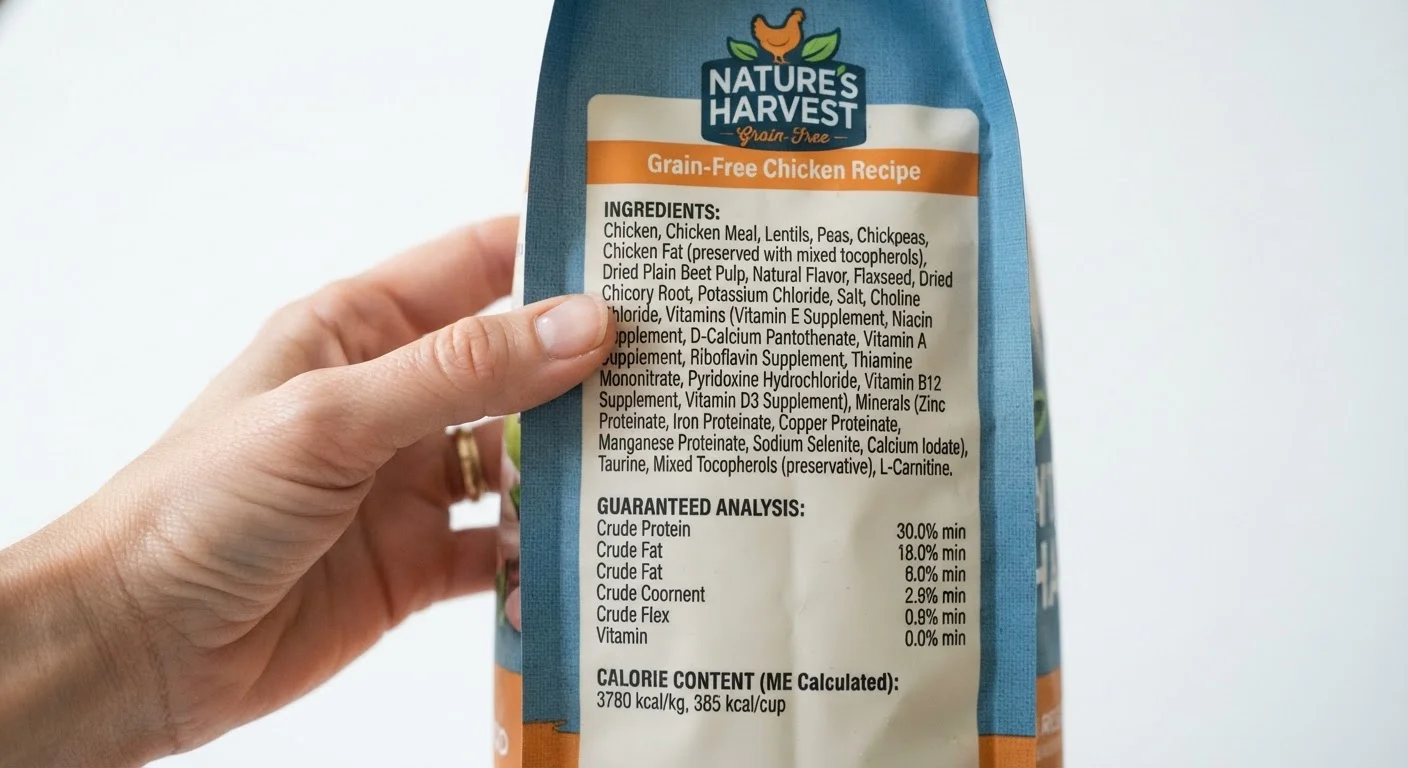
Ingredients are listed in descending order by weight before cooking. Raw meat contains a lot of water, so a "chicken" listed first may contribute less actual protein after processing than a dry ingredient like "chicken meal" listed third or fourth. "Chicken meal" is simply chicken with moisture removed - it is not a lower-quality ingredient by default.
Look at the first five to seven ingredients as a general snapshot of the food's primary composition. Whole proteins (chicken, salmon, beef), named meals (chicken meal, turkey meal), and identifiable carbohydrate sources (brown rice, oatmeal, sweet potato) are all reasonable things to see early in the list. Vague terms like "meat by-products" or "animal digest" are legal but tell you less about the source.
For a parallel breakdown of how ingredient lists work on human food products, our nutrition label explainer offers useful context.
Read the Guaranteed Analysis Panel
The guaranteed analysis lists four nutrients at minimum: crude protein (minimum %), crude fat (minimum %), crude fiber (maximum %), and moisture (maximum %). Some labels add others like taurine, omega-3 fatty acids, or calcium.
Note that "minimum" and "maximum" are not the same as actual amounts. A food guaranteeing "minimum 26% crude protein" could contain 28% or 30% - the label only commits to a floor. These are regulatory safety-net figures, not precise nutritional measurements.
Check the Feeding Guidelines - Then Adjust
Feeding guidelines are printed as general recommendations based on body weight. They are starting estimates developed by the manufacturer, not prescriptions. Factors like your pet's activity level, reproductive status, metabolism, and any underlying health conditions all affect actual caloric need.
Use the guideline as a starting point, then monitor your pet's body condition score (BCS) over several weeks. A BCS is a hands-on assessment of fat coverage over ribs and spine - your veterinarian can show you how to evaluate it. Adjust portions up or down based on whether your pet is gaining, losing, or maintaining appropriate weight.
Identify the Manufacturer and Look for Contact Information
U.S. regulations require pet food labels to include the name and address of the manufacturer, packer, or distributor. This is more useful than it sounds: it lets you contact the company directly with questions about sourcing, quality testing, or recalls. Some manufacturers conduct independent third-party testing and will share certificates of analysis on request.
Also note whether the label states where the product was made. "Made in the USA" has specific regulatory meaning; "distributed by" a U.S. company does not guarantee domestic manufacture.
Common Pitfalls and What They Mean for Your Pet
Even careful readers run into a few recurring traps. Knowing them in advance makes label-reading faster and more reliable.
Ingredient splitting
A manufacturer can list "ground corn," "corn gluten meal," and "corn flour" as separate entries. Each ranks lower than a single meat ingredient above it - but their combined weight may actually exceed that meat. This practice, sometimes called ingredient splitting, is legal and common.
Moisture differences between formats
Dry kibble typically contains 10% moisture; wet food often contains 75-78%. When you compare guaranteed analysis percentages across formats, you're not comparing apples to apples. To make a fair comparison, look up "dry matter basis" calculations, which strip out moisture before comparing nutrients. This matters most when assessing protein content between kibble and canned food.
Ask Your Vet About Dry Matter Basis
Converting nutrient percentages to a dry matter basis removes moisture from the equation and gives you an apples-to-apples comparison across food types. Many veterinary nutritionists can walk you through the calculation, or you can find the formula in AAFCO's published guidelines. This step matters most if you're transitioning between wet and dry food and want to maintain consistent protein or fat intake.
Life stage mismatches
A food marketed broadly as "for all life stages" must meet the most demanding nutritional standard - puppy or kitten growth - rather than adult maintenance. That can mean higher caloric density than an older or less active pet needs. Confirm the AAFCO statement specifies the life stage that matches your pet. For broader context on how macronutrients function differently across life stages, see our complete guide to pet nutrition.
This article provides general educational information about pet food labeling. It is not a substitute for personalized advice from a licensed veterinarian or veterinary nutritionist regarding your individual pet's dietary needs.