

Key Takeaways
Battery Degradation
Battery degradation is the gradual, permanent loss of a lithium-ion battery's ability to hold a full charge. It happens because the chemical reactions inside the battery are never perfectly reversible - each cycle causes tiny structural changes that add up over time. The result is a battery that holds less energy and drains faster than it did when new.
Degradation occurs through two main mechanisms: capacity fade (loss of active lithium ions) and power fade (increased internal resistance), both driven by electrolyte decomposition and electrode material breakdown.
The Chemistry Behind Every Lost Percent
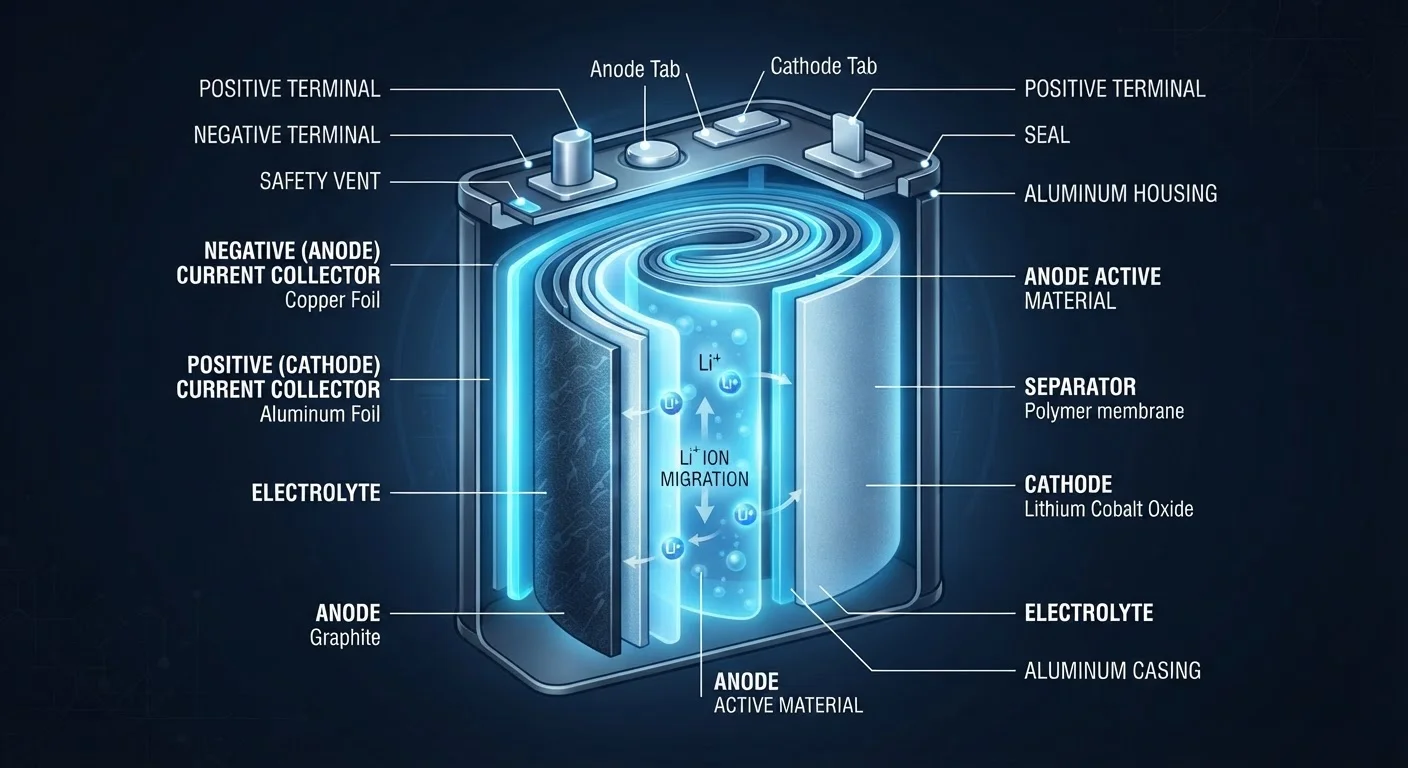
Inside every lithium-ion battery, charged lithium ions shuttle between two electrodes - a graphite anode and a metal-oxide cathode - through a liquid electrolyte. This movement is what stores and releases energy. The problem is that each trip degrades the road.
On the anode side, a thin protective film called the solid electrolyte interphase (SEI) forms during the first few charges. The SEI is actually useful - it stabilizes the electrode - but it grows thicker with every cycle, consuming lithium ions permanently and increasing the battery's internal resistance. Fewer free ions means less stored energy.
On the cathode side, repeated expansion and contraction of the electrode material causes microscopic cracks. Over hundreds of cycles, particles of active material can break off entirely, removing them from the electrochemical process. The combined effect of these two mechanisms is what engineers call capacity fade - the measurable shrinkage of a battery's maximum charge.
~20%
Typical capacity lost after 500 full cycles
Most lithium-ion cell manufacturers rate their products to retain roughly 80% capacity after 300-500 full charge-discharge cycles under standard test conditions.
2×
Faster degradation rate in high heat
Research on lithium-ion cell aging shows that sustained elevated temperatures - above 40°C (104°F) - can roughly double the rate of capacity loss compared to room-temperature storage.
20-80%
Recommended daily charge window
Battery engineers widely recommend keeping lithium-ion cells within this range for routine use to reduce electrode stress and extend usable lifespan.
What Accelerates Degradation
Not all cycles are equal. Several factors push degradation far faster than normal use would suggest.
Heat
Temperature is the dominant variable. Heat accelerates electrolyte decomposition, speeds SEI growth, and can cause permanent structural changes to electrode materials. A battery stored or operated consistently above 95°F (35°C) will lose capacity significantly faster than one kept at room temperature.
Charging to 100% - and staying there
A fully charged lithium-ion battery is under chemical stress. The cathode material is in a high-energy, unstable state, and holding it there - say, leaving a device plugged in on a hot desk all day - accelerates degradation. This is why many EV manufacturers recommend daily charging to 80% for routine use.
Deep discharges
Draining a battery to near zero forces the electrodes through their maximum expansion-contraction range. Repeated deep discharges accelerate the cracking of cathode particles. Occasional deep discharges won't ruin a battery, but making a habit of it shortens lifespan.
Fast charging
High-wattage charging pushes ions across the electrolyte quickly, which increases heat and can cause lithium to deposit unevenly on the anode - a process called lithium plating. Most devices throttle fast charging in hot conditions for exactly this reason.
Check Your Device's Battery Health
Most smartphones and laptops now include built-in battery health tools in their settings menus. These screens show your current maximum capacity as a percentage of the original design capacity - a useful baseline for tracking degradation over time. Checking this periodically can help you plan for a battery replacement before performance becomes noticeably affected.
Habits That Slow the Decline
Understanding the chemistry points directly to better habits. The goal is to reduce stress on the electrodes and limit heat exposure.
- Charge within the 20-80% range for daily use when possible. This keeps the cathode away from its most stressed states.
- Avoid leaving devices in hot environments - car interiors, direct sunlight on a windowsill, or on top of heat-generating appliances.
- Use standard charging speeds when you're not in a hurry. Fast charging is a convenience feature, not a daily necessity.
- Enable optimized or scheduled charging features if your device offers them. These features delay reaching full charge until shortly before your alarm, reducing the time spent at 100%.
If you rely on external battery packs, the same principles apply - heat management and partial charge cycles matter just as much for portable power. Our guide on getting the most from a portable power bank covers this in detail.
Degradation is inevitable, but the rate is within your control. Just as certain driving behaviors determine how long a vehicle's components last - a concept explored in our article on smart habits that help your car last longer - consistent, low-stress usage patterns make a measurable difference over years of device ownership.