

Key Takeaways
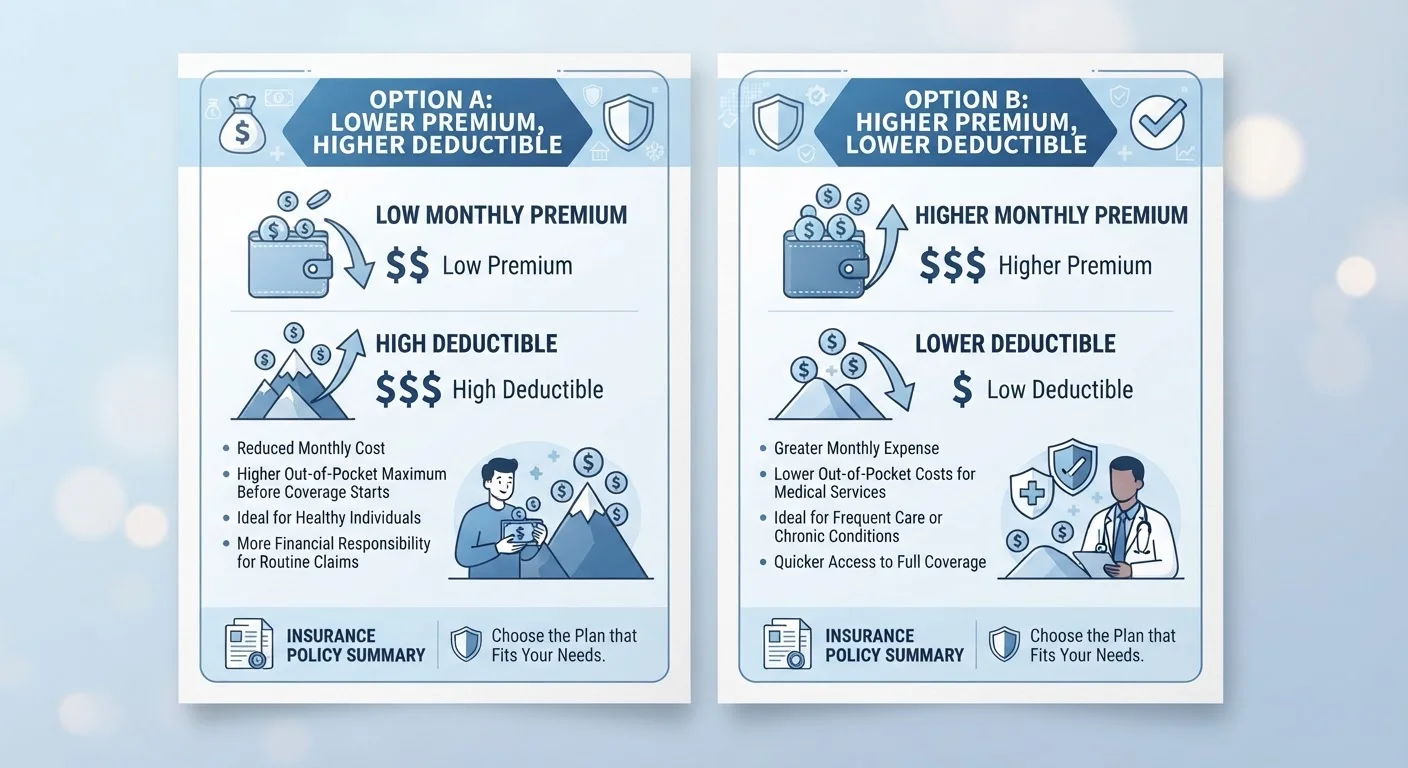
Option A
High Deductible
The lower-premium, higher out-of-pocket trade-off.
Best for: Drivers with emergency savings who rarely file claims and want to reduce monthly costs.
Option B
Low Deductible
The higher-premium, lower out-of-pocket safety net.
Best for: Drivers who want predictable, limited out-of-pocket costs when a claim occurs.
If you have solid emergency savings and a clean driving record
High Deductible
Your lower claim frequency means you'll likely pocket the premium savings over time without regularly hitting the deductible.
If you have limited savings and couldn't cover a large unexpected expense
Low Deductible
A lower deductible caps your immediate out-of-pocket costs after an accident, preventing financial strain at an already stressful moment.
If you drive an older vehicle with a lower market value
High Deductible
When a car's value is modest, a high deductible relative to its worth may eliminate the financial benefit of filing a comprehensive or collision claim.
If you drive frequently in high-traffic or high-risk environments
Low Deductible
Greater exposure to potential incidents makes the predictable out-of-pocket cost of a low deductible more valuable.
The Core Relationship: How Deductibles and Premiums Work Together
A deductible is the dollar amount you agree to pay out of pocket before your insurer covers the rest of an eligible claim. A premium is the recurring amount - monthly, semi-annual, or annual - that you pay to keep your policy active. These two numbers move in opposite directions: raise one, and the other tends to fall.
This inverse relationship exists because a higher deductible shifts more financial risk to you, the policyholder. Insurers price that risk into your premium. When you absorb a greater share of potential costs, your insurer's exposure decreases, and it typically reflects that by charging less. For a fuller explanation of how insurers set your rate in the first place, see why your car insurance rate is what it is.
It's also worth noting that deductibles don't apply to every coverage type. Liability coverage - which pays for damage or injuries you cause to others - carries no deductible. Deductibles typically apply to collision (damage from an accident involving your vehicle) and comprehensive (damage from events like theft, weather, or falling objects) coverage. For a quick reference on these terms, the auto insurance terminology glossary is a useful starting point.
| Criterion | High Deductible | Low Deductible |
|---|---|---|
| Monthly/annual premium | Lower | Higher |
| Out-of-pocket cost at claim time | Higher (e.g. $1,000-$2,000) | Lower (e.g. $250-$500) |
| Risk carried by policyholder | More | Less |
| Best outcome scenario | No claims filed; savings accumulate | Claim filed; limited surprise costs |
| Suits drivers with... | Strong savings, low claim history | Limited savings, higher exposure |
| Impact on older/lower-value vehicles | May reduce net payout significantly | More proportionate to vehicle value |
Calculating Your Break-Even Point
Choosing between a high and low deductible isn't just about monthly cash flow - it's a math problem with a personal answer. The concept of a break-even point helps frame the decision: how long would you need to go without filing a claim for the premium savings from a high deductible to outweigh the extra out-of-pocket cost if something did go wrong?
Here's a simplified example: Suppose raising your deductible from $500 to $1,000 saves you $150 per year in premiums. Your extra risk is $500 (the difference between deductibles). Dividing $500 by $150 gives roughly 3.3 years. If you go more than three years without a collision or comprehensive claim, the high-deductible option comes out ahead financially. If you file a claim within that window, the lower deductible would have served you better.
$500
Most common collision deductible chosen
Industry data consistently shows $500 as the deductible level most frequently selected by drivers for collision coverage, balancing premium savings and out-of-pocket risk.
~10-15%
Typical premium reduction from doubling deductible
Insurers generally estimate that moving from a $500 to a $1,000 deductible can reduce collision or comprehensive premiums by roughly 10-15%, though actual savings vary by insurer and driver profile.
No formula can predict when you'll have an accident, but your driving history, commute length, and local road conditions can all inform a realistic estimate. Factors that influence your premium beyond deductible choices are worth understanding too - see things that can affect your auto insurance premium.
The Critical Rule: Only Choose a Deductible You Can Afford to Pay
The most common mistake drivers make when adjusting their deductible is selecting a number that looks good on a quote but isn't actually available in their bank account. A deductible is due at claim time - often a stressful moment after an accident or theft. If you can't cover that amount quickly, you may not be able to get your vehicle repaired or replaced promptly.
Before raising your deductible to reduce your premium, honestly assess your liquid savings. Financial planning frameworks - like those covered in budgeting basics - can help you determine whether you have the cash buffer to support a higher deductible comfortably. If your emergency fund is thin, a lower deductible provides a real safety net, even if it costs more each month.
Also consider your vehicle's actual market value. If your car is worth $4,000 and you carry a $2,000 deductible, the net payout from a total-loss claim shrinks significantly. At some point, the economics of carrying collision or comprehensive coverage at all may not hold up - a licensed insurance agent can help you evaluate that threshold for your specific situation.
Understanding the full picture of your coverage - including what a policy actually protects - is equally important. The article on state minimums vs. full coverage explains how coverage levels interact with costs and protections.
This article provides general educational information about auto insurance concepts and is not a substitute for personalised advice from a licensed insurance professional. Coverage terms, deductible options, and premium impacts vary by insurer, policy, and state. Always review your actual policy documents and consult a licensed agent before making changes to your coverage.