

Key Takeaways
Nutrition Facts Label
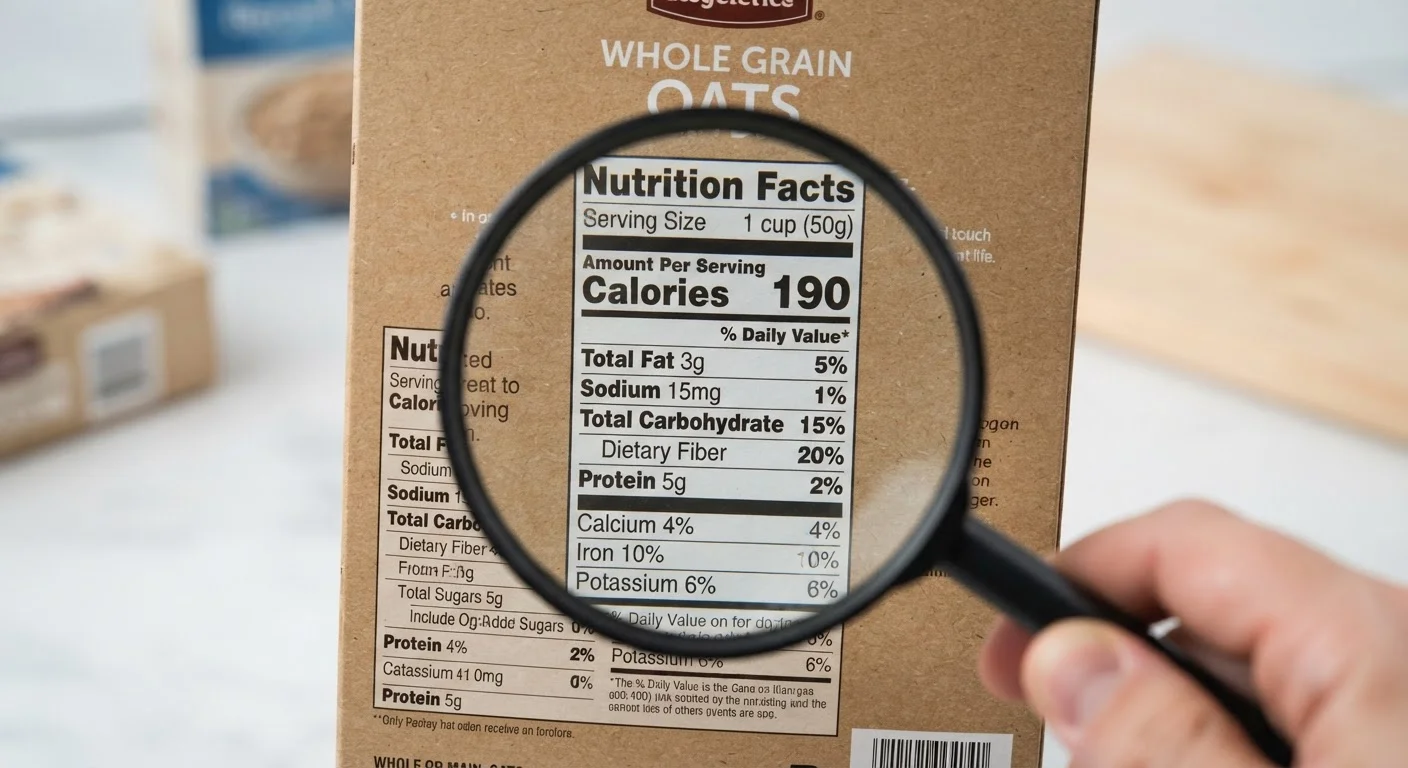
A Nutrition Facts label is the standardized panel printed on packaged food and beverage products in the United States. It discloses key nutritional information - including calories, macronutrients, and certain vitamins and minerals - per serving. The goal is to help consumers understand what they're eating and compare products at a glance.
The current label format is regulated by the FDA and reflects updated dietary guidance, including mandatory disclosure of added sugars and vitamin D, which were added in the 2016 redesign.
Start with Serving Size - Everything Else Depends on It
The serving size sits at the very top of the Nutrition Facts panel for good reason: every calorie count and every nutrient figure below it refers to that specific portion. If a bag of chips lists a serving as 1 ounce (about 15 chips) but you eat twice that, you've consumed double every number on the label.
The FDA updated serving sizes in the 2016 label redesign to better reflect amounts people actually eat - so a can of soup that was previously labeled as two servings may now be listed as one. This makes comparisons more realistic, but it also means you can't assume older and newer packages use the same benchmark. Always read this line first.
Check Servings Per Container First
Before reading any other number, find 'servings per container' just above the serving size. A product that looks modest in calories can be misleading if it contains three or four servings in a single package. This one step reorients every other figure on the label.
Calories and Macronutrients: What the Numbers Mean
Calories measure total energy from a food. Below that, the label breaks energy sources into three macronutrients: fat, carbohydrates, and protein.
- Total Fat is divided into saturated fat and trans fat. Saturated fat is associated with cardiovascular risk factors when consumed in excess; trans fat is largely phased out of the U.S. food supply but still appears in trace amounts.
- Total Carbohydrates include dietary fiber, total sugars, and - now required - added sugars. Dietary fiber is listed separately because it contributes to digestive health and is not fully broken down for energy.
- Protein is listed in grams but does not carry a required %DV. Protein needs vary significantly by age, body size, and activity level.
Cholesterol and sodium follow fat on the label and each carry a %DV because both are linked to cardiovascular health at high intakes for many people.
~70%
Americans who read nutrition labels
According to FDA consumer research, a majority of U.S. adults report using the Nutrition Facts label when choosing food products.
2,300mg
Daily sodium reference value for adults
The FDA uses 2,300mg as the daily reference value for sodium on the Nutrition Facts label, aligning with federal dietary guidelines.
50g
Daily reference value for added sugars
The FDA's daily reference value for added sugars - the basis for the %DV calculation on the label - is 50 grams per day for a 2,000-calorie diet.
Percent Daily Value: A Useful Shortcut, Not a Personal Prescription
The Percent Daily Value (%DV) column is one of the most practical tools on the label. It benchmarks each nutrient against the daily intake recommended for a reference adult consuming 2,000 calories. The FDA provides a simple rule of thumb: 5% DV or less is low for a nutrient; 20% DV or more is high.
This scale works in both directions. For nutrients you want more of - like fiber, calcium, vitamin D, and potassium - aim for higher %DVs. For nutrients you want less of - saturated fat, sodium, and added sugars - look for lower %DVs.
Keep in mind that 2,000 calories is a reference point, not a universal recommendation. Children, older adults, pregnant individuals, and those with specific health conditions may have very different needs. A registered dietitian can help translate label numbers into personal context. This label information is general education, not medical or dietary advice tailored to you.
The 2,000-Calorie Reference Is Not Universal
The Percent Daily Values on the label are calculated for a reference adult consuming 2,000 calories per day. This is a standardization tool, not a recommendation for everyone. Caloric needs vary considerably based on age, sex, body size, and activity level. Use %DV as a comparative tool between products rather than a strict personal target.
Vitamins, Minerals, and the Ingredient List
The bottom of the Nutrition Facts panel lists select micronutrients - currently vitamin D, calcium, iron, and potassium - all required disclosures because Americans commonly fall short of these. Each is shown as a %DV so you can quickly see whether a food meaningfully contributes to your intake.
Below the Nutrition Facts panel sits the ingredient list, which is separate but equally informative. Ingredients are listed in descending order by weight - the first ingredient makes up the largest share of the product by mass. A product with whole grain as its first ingredient contains more of that grain than any other single component. Conversely, if multiple forms of sugar appear across the first several ingredients, the cumulative amount may be higher than it first appears.
Reading labels across food categories follows a similar logic to other consumer products. Just as decoding a skincare ingredient list requires understanding ordering and terminology, food labels reward familiarity with a few core rules.
This article is for general informational and educational purposes only and is not a substitute for professional dietary or medical advice. Consult a qualified healthcare provider or registered dietitian for guidance specific to your health needs.