

Key Takeaways
Option A
Tankless Water Heater
The compact, on-demand heating solution.
Best for: Households with moderate to high hot water demand and upfront budget flexibility who want long-term energy savings and space efficiency.
Option B
Traditional Tank Water Heater
The proven, widely accessible standard.
Best for: Homeowners seeking lower upfront costs, simpler installation, and straightforward replacement in existing setups.
If you want lower upfront costs and a simple swap
Traditional Tank Water Heater
Tank heaters cost significantly less to purchase and install, and replacement is straightforward when an existing tank setup is already in place.
If you want to reduce long-term energy costs
Tankless Water Heater
Because tankless units only heat water when needed, they avoid the standby heat loss that tank heaters experience around the clock.
If space is limited or you want a low-profile installation
Tankless Water Heater
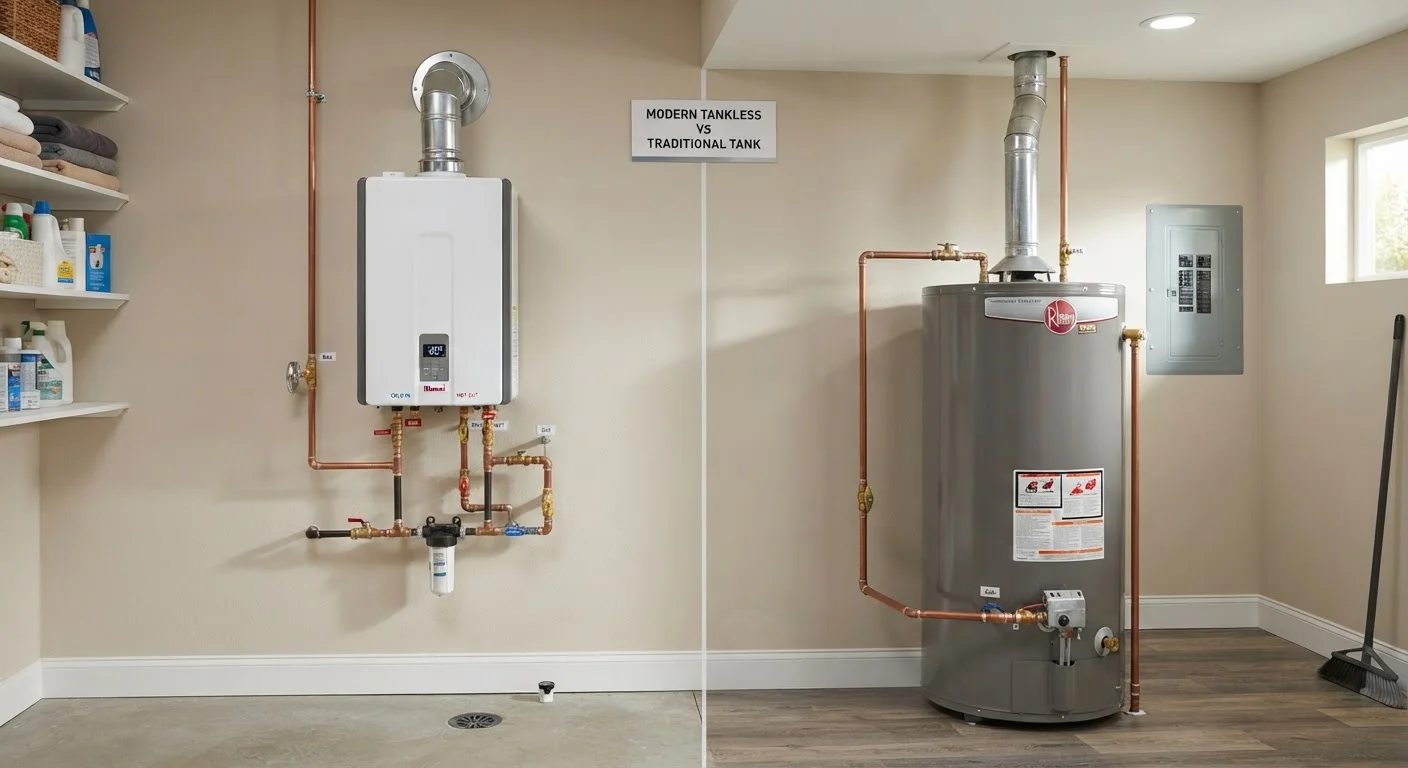
Tankless units mount on a wall and occupy a fraction of the footprint of a standard 40-80 gallon storage tank.
If your household runs multiple hot-water fixtures simultaneously
Tankless Water Heater
A properly sized tankless unit delivers continuous hot water without the risk of depleting a stored supply during peak demand.
If your home has older infrastructure and a tight timeline
Traditional Tank Water Heater
Tank units work with most existing gas, electric, and venting configurations, minimizing retrofit work and installation time.
How Each System Works
A traditional tank water heater stores a large volume of water - typically 30 to 80 gallons - and keeps it heated continuously, ready for use at any tap. This process, called standby heating, means energy is consumed even when no one is using hot water. A thermostat triggers the burner or heating element whenever the stored water drops below a set temperature.
A tankless water heater (also called an on-demand or instantaneous heater) has no storage tank. Instead, cold water passes through a heat exchanger the moment a hot-water tap is opened. The unit fires up, heats the water rapidly, and shuts off when demand stops. Because there is no stored water to keep warm, standby energy loss is largely eliminated.
Understanding this fundamental difference - stored heat versus on-demand heat - explains most of the trade-offs discussed below. If your home has older plumbing you're still learning about, our guide on plumbing shutoffs every homeowner should know is a useful companion read.
| Criterion | Tankless Water Heater | Traditional Tank Water Heater |
|---|---|---|
| Upfront Cost | Higher ($500-$2,000+) | Lower ($300-$1,500) |
| Installation Complexity | Often more complex; may need upgrades | Generally straightforward replacement |
| Energy Efficiency | Higher (no standby heat loss) | Lower (continuous standby heating) |
| Hot Water Supply | Continuous (limited by flow rate) | Finite (limited by tank capacity) |
| Lifespan | 20+ years | 10-15 years |
| Space Required | Minimal (wall-mounted) | Significant floor footprint |
| Maintenance | Annual descaling in hard-water areas | Periodic flushing; anode rod replacement |
| Best Climate Fit | Most climates; inlet temp affects output | Any climate |
Cost, Lifespan, and Energy Efficiency
The financial picture involves both short-term and long-term considerations, and neither system wins on every front.
Upfront Cost
Traditional tank heaters generally cost between $300 and $1,500 for the unit, with installation often ranging from $150 to $600 depending on your region and the complexity of the job. Tankless units typically run $500 to $2,000 or more for the equipment alone, and installation can add $1,000 or higher if gas line upgrades, new venting, or dedicated electrical circuits are needed.
Operating Cost
The U.S. Department of Energy estimates that on-demand heaters can be 24-34% more energy efficient than conventional tank heaters for homes using up to 41 gallons of hot water per day. The gap narrows as daily usage increases, but most households still see meaningful energy reductions over time.
24-34%
Potential energy savings with tankless units
According to the U.S. Department of Energy, for homes using roughly 41 gallons of hot water daily or less.
10-15 yrs
Average lifespan of a tank water heater
Industry estimates suggest traditional tank heaters typically last 10 to 15 years with routine maintenance.
20+ yrs
Typical lifespan of a tankless unit
Tankless water heaters, when properly maintained, commonly exceed 20 years of service life.
Lifespan
Traditional tank heaters average 10-15 years. Tankless models, when properly maintained, commonly last 20 years or more. The longer lifespan of tankless units can offset their higher initial price over time, though this depends heavily on local water quality and routine upkeep such as annual descaling in hard-water areas.
Water heater efficiency also connects to broader home energy costs. If you've noticed unexpectedly high utility bills, see our article on hidden causes of high energy bills in older homes for a broader look at where heat loss commonly occurs.
Performance, Installation, and Practical Fit
Beyond cost, day-to-day performance and your home's infrastructure play a major role in which type makes sense.
Hot Water Availability
A tank heater's capacity is finite. Run a dishwasher, two showers, and a washing machine simultaneously, and you may exhaust the supply and wait 20-40 minutes for recovery. Tankless units deliver a continuous stream but have a flow rate limit - measured in gallons per minute (GPM). A single unit rated at 5-8 GPM handles most households comfortably, though very large homes may need two units or a larger model.
Installation Considerations
Replacing a tank unit with another tank unit is usually the simplest scenario - existing connections and venting often need only minor adjustment. Converting to tankless can be more involved. Gas tankless heaters require higher-capacity gas lines and sealed venting systems. Electric tankless units often demand dedicated high-amperage circuits that older panels may not support. Always have a licensed plumber or contractor assess your home before committing to a conversion.
Hard Water Can Affect Both Types
In areas with high mineral content in the water supply, scale buildup inside heat exchangers and tank walls is a real concern. Tankless units are particularly sensitive and may require annual descaling to maintain efficiency and prevent damage. Traditional tanks benefit from periodic flushing and anode rod checks. A water softener or descaling service can extend the life of either system in hard-water regions.
Space and Flexibility
Tank heaters occupy a substantial footprint - typically a cylindrical unit 54-60 inches tall and 20 inches or more in diameter. Tankless units mount flush on a wall and can fit inside a cabinet or closet, freeing up floor space in utility rooms. For smaller homes or those embracing a more efficient use of space, this difference is tangible. Our article on minimalist living trade-offs touches on how appliance footprints factor into household decisions.
Before making a final choice, review local permit requirements. Most municipalities require permits for water heater installation, and work must typically be inspected - especially for gas appliances. It's also worth checking whether your home maintenance assumptions are accurate, since some common beliefs about appliance upkeep can lead to preventable costs.
This article is for general informational purposes only. Installation of water heaters involves gas, electrical, and plumbing systems that may be hazardous. Always consult a licensed professional and verify local permit requirements before undertaking any installation or replacement work.