

Key Takeaways
Why Small Spaces Demand Better Systems
In a compact apartment or small home, disorganization has immediate consequences: counters fill fast, pathways narrow, and the psychological weight of visible clutter becomes a daily friction point. But the solution isn't always more storage - it's smarter systems designed to hold up under real daily use, not just look good after a Sunday afternoon tidy.
The strategies below aren't about achieving a magazine-perfect aesthetic. They're about building habits and structures that remain functional over months and years, even as life shifts around them. Whether you're in a studio apartment, a small rental, or simply working with a single cramped room, these approaches give you a practical starting point.
Start With One Zone, Not the Whole Home
Overhauling an entire small space at once often leads to abandoned mid-project chaos. Instead, choose one specific zone - a single kitchen drawer, the entryway, or one closet shelf - and build a system that works there before moving on. Early wins build momentum and give you a template to replicate elsewhere in the home.
Seven Strategies Worth Building Into Your Home
Treat Vertical Space as Prime Real Estate
Most small-space dwellers focus on floor-level storage and overlook the several feet of usable wall space above eye level. Shelving that extends toward the ceiling can hold seasonal items, reference books, or display objects without crowding the room. The key is keeping frequently used items within easy reach and reserving higher shelves for things accessed only a few times a year.
Wall-mounted hooks, pegboards in kitchens or entryways, and over-door organizers are cost-effective ways to reclaim surface area. For a deeper look at how vertical layering works as a structural principle, see vertical storage principles that professional organizers rely on.
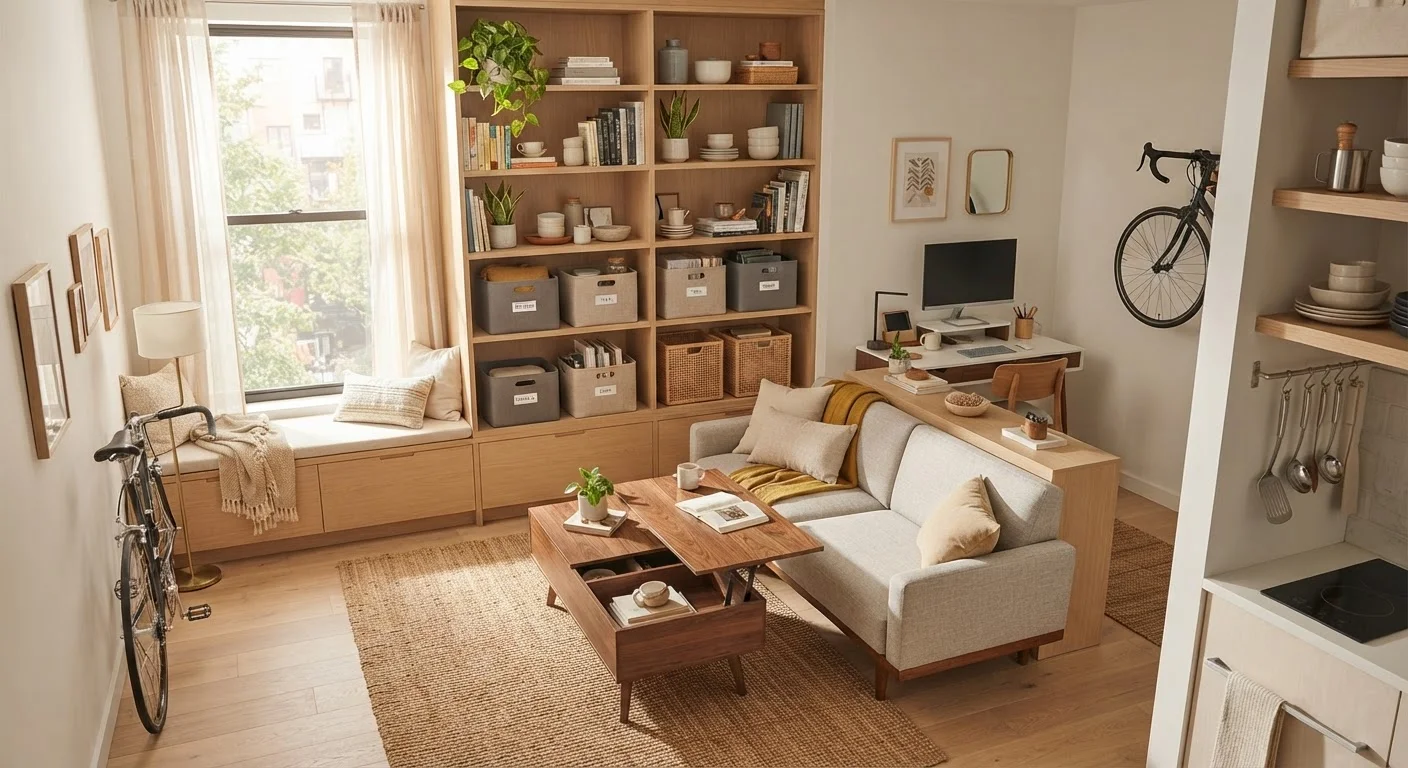
Shelving that reaches the ceiling can house a year's worth of seasonal storage without touching the floor.
Choose Furniture That Earns Its Footprint
Every piece of furniture in a compact home should justify the space it occupies. Ottoman storage, bed frames with drawers, and dining benches with lift-top compartments all provide hidden capacity without adding visual bulk. When evaluating a new furniture piece, a useful question is: does this do at least two jobs well?
Nesting tables, fold-down desks, and extendable dining tables are practical examples that adapt to changing needs throughout the day. The goal is not to cram in more storage, but to select pieces whose dual purposes make the room genuinely more livable.
Ask whether each furniture piece does at least two jobs well before it earns a spot in your home.
Create Category Zones Rather Than Room-Based Rules
Assigning items to zones based on category - rather than simply putting things where they seem to fit - produces systems that are easier to maintain. A charging zone near the entryway, a bill-paying zone at a desk, and a crafting zone in a closet corner each give specific items a predictable home. When everything has a designated zone, returning items becomes nearly automatic.
This approach is especially effective in studio apartments and open-plan spaces where distinct rooms don't exist. Rugs, lighting, and shelving units can physically define zones even in a single large room. The room-by-room organization guide offers a comprehensive look at applying this thinking throughout your home.
Zones based on category - not room location - give every item a predictable, returnable home.
Edit Regularly Rather Than Reorganizing Occasionally
One of the most common pitfalls in small-space organization is treating it as a one-time event. Clutter accumulates gradually, and a quarterly habit of editing - removing items that are broken, unused, or duplicated - prevents the slow drift back toward disorder. A 15-minute monthly walkthrough per zone is more effective than a full weekend overhaul twice a year.
If your organized spaces tend to deteriorate quickly, the issue is rarely the storage system itself. Why reorganized spaces fall back into chaos explains the underlying patterns that cause this and offers concrete ways to interrupt the cycle.
A 15-minute monthly edit per zone prevents more clutter than a twice-yearly full overhaul.
Use Uniform, Stackable Containers Within Storage Areas
Mismatched bins and boxes waste space and make storage areas harder to navigate. Standardizing container sizes within a cabinet, closet, or shelf section allows for true stacking, maximizes cubic footage, and makes it easier to see - or label - what's inside. Transparent containers work well for items accessed frequently; opaque ones suit things stored out of sight long-term.
Labels don't need to be elaborate. A simple handwritten tag or removable adhesive label reduces the time spent searching and helps other household members maintain the system. For shared living situations, clear labeling is particularly important; organizing a home with multiple people covers how to build systems that work across different habits.
Uniform, stackable containers turn wasted air space inside cabinets into real, usable storage capacity.
Apply a One-In, One-Out Rule for High-Turnover Categories
Clothing, kitchen gadgets, books, and personal care products tend to accumulate fastest in small homes. A one-in, one-out rule - removing or donating one item every time a new one enters the home in that category - keeps those areas from exceeding their allocated space. This is not a rigid minimalist philosophy; it's a practical throttle that keeps storage systems from being chronically overwhelmed.
Readers curious about the philosophical dimensions of this kind of restraint may find value in comparing KonMari vs. minimalist approaches to see which framework aligns better with their household's values and lifestyle.
A one-in, one-out rule is a practical throttle - not a lifestyle mandate - that keeps categories in check.
Store Items at the Point of Use
Items stored far from where they are used tend to get left out rather than returned. A hook for keys directly beside the front door, a small tray for remote controls at the couch, and a designated spot for scissors in both the kitchen and home office all reduce the friction that leads to clutter. The closer storage is to the point of use, the more likely the habit of returning items will stick.
This principle also applies to seasonal or sentimental items. If keepsakes are difficult to access or require too much effort to put away properly, they end up in catch-all piles. Storing sentimental items without letting them take over walks through thoughtful strategies for giving meaningful belongings a real, maintainable home.
Storage placed at the point of use removes friction - and friction is what turns good intentions into clutter.
Organization Costs Don't Have to Be High
Effective small-space organization rarely requires expensive products. Many of the most durable systems rely on consistent habits and thoughtful placement rather than specialty storage purchases. If you're working within a tight household budget, prioritize editing what you own before investing in new containers or furniture. For broader budgeting context, general guidance on managing household spending can help you evaluate where organizational investments make the most sense.
Building Systems That Last
The most effective small-space organizations share one trait: they're designed around how people actually behave, not how they intend to behave. A system that requires perfect discipline every day will fail; one that makes the right action slightly easier than the wrong one will generally hold.
Revisit your organization systems periodically - not to overhaul them, but to adjust for changes in your household, habits, or possessions. For a comprehensive room-by-room perspective on applying these principles throughout your entire home, the complete home organization walkthrough provides detailed, space-specific guidance you can work through at your own pace.