

Key Takeaways
Option A
Zero-Based Budgeting
The meticulous, dollar-by-dollar planning method.
Best for: People who want complete control over every dollar they earn each month.
Option B
The Envelope Method
The tactile, cash-first spending discipline system.
Best for: People who overspend in specific categories and benefit from a hard physical limit.
If you want a comprehensive monthly plan that accounts for every dollar
Zero-Based Budgeting
Zero-based budgeting forces you to plan for every expense category upfront, making it ideal for those who want a full financial picture each month.
If you consistently overspend in categories like dining out or entertainment
The Envelope Method
Physical cash limits make it nearly impossible to exceed your allocation - a concrete boundary that digital tracking alone often fails to provide.
If you prefer managing finances digitally without handling cash
Zero-Based Budgeting
Zero-based budgeting adapts well to spreadsheets and apps, making it the more practical digital-first choice.
If you're new to budgeting and need a simple, visual system
The Envelope Method
The envelope method is straightforward - label envelopes, fill them, spend from them. The simplicity makes it accessible for first-time budgeters.
If your income varies month to month
Zero-Based Budgeting
Zero-based budgeting is rebuilt from scratch each month, making it easier to adapt allocations when your income fluctuates.
How Each Method Works
Both zero-based budgeting and the envelope method share a foundational philosophy: intentional spending. But their mechanics are quite different.
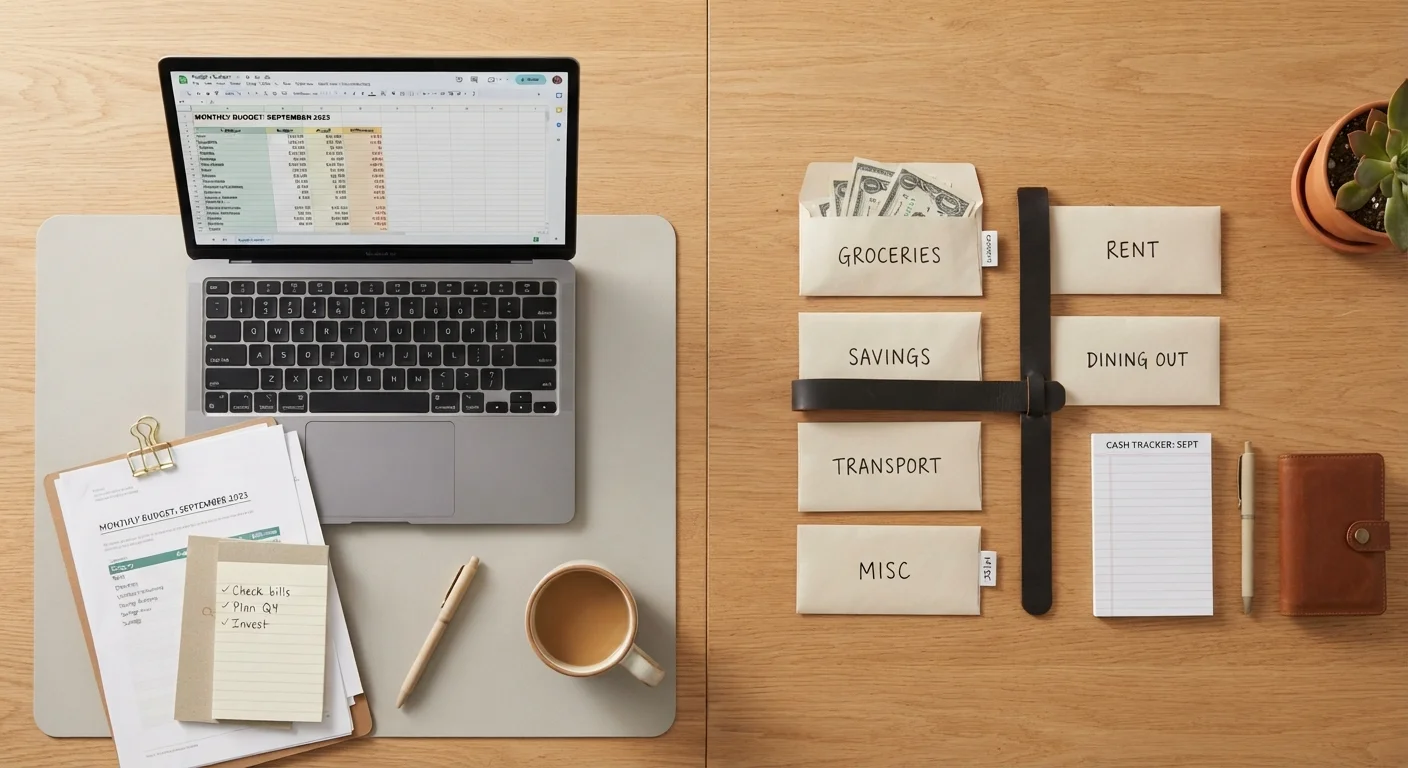
Zero-based budgeting (ZBB) starts with your total monthly income and assigns every dollar a category - rent, groceries, savings, debt payments, entertainment - until income minus all assigned amounts equals zero. That doesn't mean spending everything; savings and investments count as budget categories too. The goal is that no dollar is unaccounted for. If you earn $4,000 a month, you plan out all $4,000. Before starting, it helps to understand core concepts - see our budgeting terms glossary for clear definitions of income, discretionary spending, and more.
The envelope method is more hands-on. You divide your income - or a portion of it - into physical envelopes labeled by spending category. Groceries get $400 in cash; dining out gets $150; personal care gets $75. When an envelope is empty, spending in that category stops for the month. Some people apply this logic digitally using sub-accounts or apps, though the original system is cash-based.
| Criterion | Zero-Based Budgeting | The Envelope Method |
|---|---|---|
| Core mechanism | Assign every dollar a category until balance = zero | Fill labeled envelopes with cash; spend from them |
| Format | Digital-friendly (spreadsheet or app) | Traditionally cash-based; digital adaptations exist |
| Spending limit enforcement | Self-enforced through tracking | Automatic - cash runs out physically |
| Flexibility for variable income | High - rebuilt fresh each month | Moderate - requires adjusting cash amounts |
| Learning curve | Moderate - requires planning every category | Low - simple concept, minimal setup |
| Best coverage for fixed bills | Excellent - all bills assigned in the plan | Limited - works best for variable expenses |
| Behavioral friction against overspending | Moderate - relies on checking your budget | High - empty envelope stops spending naturally |
Strengths and Limitations of Each Approach
Zero-based budgeting excels at giving you a complete, monthly snapshot of your finances. Because you rebuild the budget each month, it naturally adapts to irregular expenses like quarterly insurance premiums or seasonal costs. It also makes it easy to redirect money - if you underspend in one category, you can consciously move those dollars elsewhere. For a detailed look at the trade-offs of this level of granularity, see our article on the pros and cons of budgeting every single expense.
The envelope method's greatest strength is behavioral: physical cash creates a psychological limit that card swiping simply doesn't. Research in behavioral economics consistently suggests people spend more freely with cards than with cash, because parting with physical money feels more tangible. The limitation is practical - carrying cash is less convenient, and the system doesn't cover fixed digital expenses like utility autopay or mortgage payments as cleanly.
A Note on Digital Envelope Systems
Several budgeting apps now replicate the envelope method digitally using virtual spending categories or sub-accounts. While these preserve the category-cap logic, they forgo the behavioral impact of physical cash. If overspending is your primary challenge, a true cash-envelope system may deliver stronger results, at least initially. Consider testing the cash version first before moving to a digital equivalent.
Neither method suits every lifestyle. If you have irregular income, a variable-income adaptation of zero-based budgeting - where you budget from a conservative baseline - may serve you better than either standard approach. Consulting a certified financial planner can help you tailor any system to your specific situation.
Choosing the Right System for Your Habits
The best budgeting method is the one you'll actually maintain. A few questions can help clarify which approach fits:
- Do you struggle with impulse purchases? The envelope method's hard cash cap addresses this directly.
- Do you prefer digital tools? Zero-based budgeting integrates well with spreadsheets - explore how to combine methods in our spreadsheet vs. budgeting app comparison.
- Is your income variable? Zero-based budgeting's monthly rebuild is more flexible.
- Are you new to budgeting altogether? Our first budget guide walks through the foundational steps before you commit to any method.
~1 in 3
Americans with a detailed monthly budget
Gallup polling has consistently found that fewer than one in three U.S. adults maintain a detailed household budget, suggesting most people manage finances without a formal system.
12-18%
Typical overspend without a spending plan
Consumer finance research broadly suggests households without a formal budget tend to spend a meaningful share of discretionary income beyond their intentions, though exact figures vary by study.
Some people blend both: using zero-based budgeting for the full monthly plan while applying envelope-style cash limits to high-risk spending categories. That hybrid approach can capture the planning depth of ZBB and the behavioral guardrails of the envelope system. For broader context on how these approaches compare with frameworks like 50/30/20, see our budgeting frameworks comparison.
This article is for general informational and educational purposes only and does not constitute personalized financial advice. Readers should consult a qualified financial professional for guidance specific to their circumstances.