

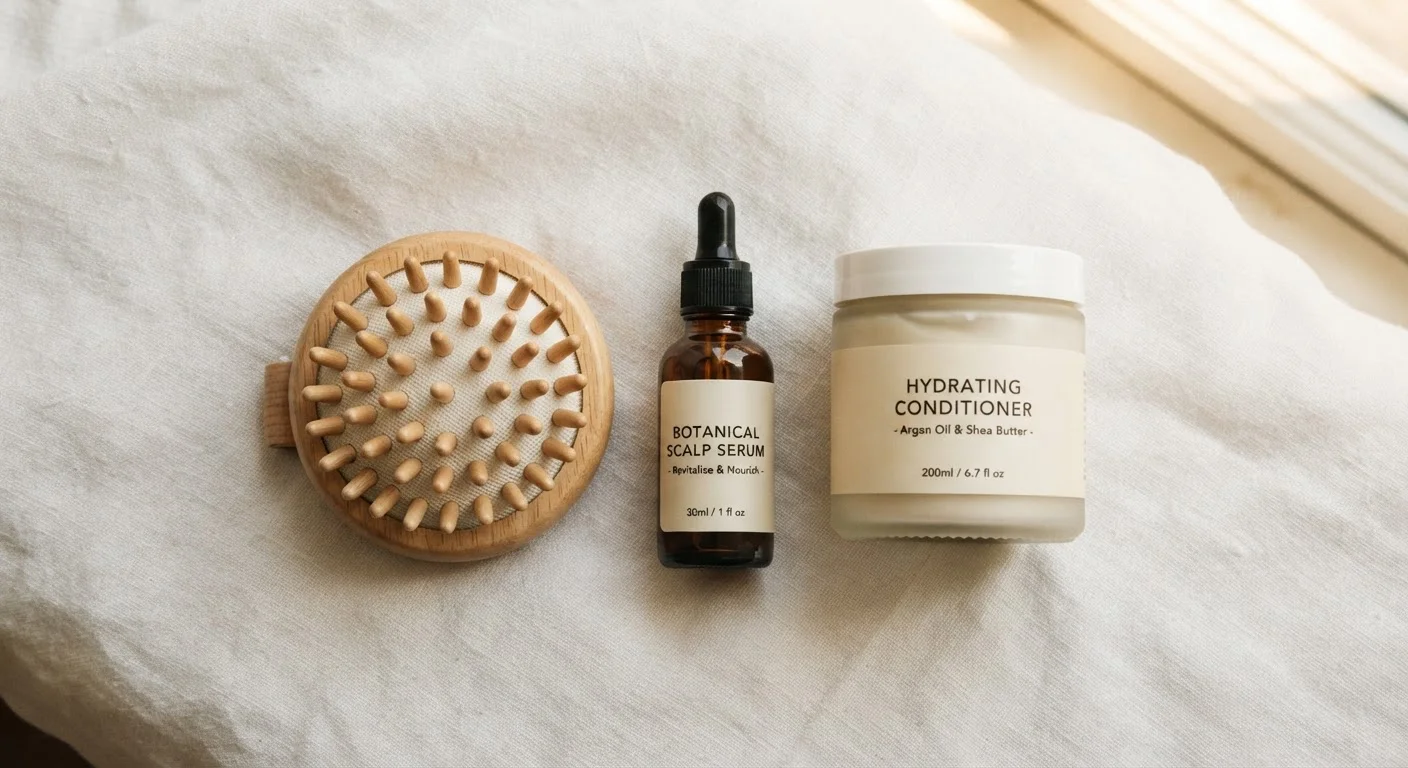
Key Takeaways
Option A
Scalp Care
The foundation-first approach to hair health.
Best for: Anyone dealing with dryness, flakiness, excess oil, sensitivity, or slow hair growth who wants to address root causes rather than surface symptoms.
Option B
Hair Care
The visible-results side of your grooming routine.
Best for: Anyone focused on improving the texture, shine, strength, and manageability of the hair strand itself - from ends to mid-shaft.
If you experience persistent flakiness, itchiness, or an oily scalp
Scalp Care
These symptoms originate at the skin level. Scalp-focused products - think scalp serums, exfoliating treatments, and targeted cleansers - address the environment where hair actually grows.
If your main concerns are dry, brittle, or frizzy hair strands
Hair Care
Damage along the hair shaft responds to conditioning treatments, masks, and leave-ins designed to coat and strengthen the strand - territory that scalp products don't cover.
If you want to support healthier long-term hair growth
Scalp Care
A well-maintained scalp environment supports follicle function. Addressing circulation, buildup, and inflammation at the root level lays the groundwork for stronger new growth.
If you want a complete, balanced grooming routine
Scalp Care
Most complete routines benefit from both - but scalp care is the step most commonly skipped. Starting there fills the gap that hair products alone cannot.
Two Different Targets, Two Different Approaches
Here's a distinction that changes everything: your scalp is skin. It has pores, produces sebum (oil), sheds dead cells, and can become irritated, congested, or imbalanced - just like the skin on your face. Hair care, on the other hand, targets the fiber itself: the strands that grow out of those follicles.
Most mainstream grooming routines treat the two as interchangeable. Shampoo reaches the scalp, sure - but its primary job is cleansing the hair shaft and rinsing away product buildup. Conditioner is almost never meant to sit on your scalp at all. The result? Millions of people are diligently moisturizing their ends while completely overlooking the environment where every strand originates.
Think of it this way: you wouldn't substitute face wash for a targeted acne serum and expect the same results. The same logic applies here. Just as understanding the difference between skin type and skin condition reshapes your facial routine, recognizing that your scalp has its own distinct needs reshapes your hair routine.
| Criterion | Scalp Care | Hair Care |
|---|---|---|
| Primary target | Scalp skin and follicles | Hair shaft and strands |
| Key concern addressed | Oiliness, flakiness, buildup, irritation | Dryness, breakage, frizz, dullness |
| Main product types | Scalp serums, exfoliants, targeted cleansers | Conditioners, masks, leave-ins, oils |
| Application zone | Directly on the scalp skin | Mid-shaft to ends |
| Effect on hair growth | Supports follicle environment | Does not directly influence follicles |
| How often needed | Regular; varies by scalp type | Each wash or as needed for strand condition |
What Scalp Care Actually Involves
Scalp care focuses on the environment - keeping the skin clean, balanced, and free of buildup so that follicles can function well. Key practices include:
- Exfoliation: Scalp exfoliants (both physical and chemical) remove the dead skin cells and product residue that can clog follicles and contribute to flakiness. This is not something a regular conditioner does.
- Targeted cleansing: The frequency and type of shampoo matters. If you're navigating wash-day decisions, how often you should actually wash your hair depends heavily on your scalp's oiliness - not just your hair type.
- Scalp serums and treatments: These lightweight formulas are designed to be applied directly to the skin, addressing concerns like dryness, sensitivity, or buildup at the source.
- Scalp massage: Gentle massage may support circulation in the scalp, which some research suggests could benefit follicle stimulation - though results vary and more study is needed.
~100,000
Hair follicles on the average human scalp
Dermatologists commonly cite this figure to highlight how significant the scalp's follicle density is - each one relying on a healthy skin environment to function.
28 days
Approximate scalp skin cell turnover cycle
Like facial skin, the scalp sheds and renews its outer skin layer roughly every four weeks, making exfoliation a relevant part of scalp maintenance.
If you're curious about what your hair's behavior might be signaling beneath the surface, signs your hair may be telling you something about your scalp health is worth exploring.
What Hair Care Does (and Doesn't Do)
Hair care products are engineered for the strand - the dead, keratinized fiber that grows outward from the follicle. Conditioners, masks, and leave-ins work by coating the hair shaft, smoothing the cuticle layer, and reducing friction and breakage. They're genuinely effective at what they do. They just don't do anything for the skin underneath.
A common misconception is that deep conditioning treatments nourish hair at the root. In reality, the living portion of hair - the part where growth and cellular activity happen - is inside the follicle, well below the surface. Products applied to the strand can't reach or influence that biology.
Shampoo formulation also matters more than most people realize. How sulfate-free and regular shampoos differ can affect both strand integrity and scalp sensitivity - so the cleansing step is genuinely a bridge between both categories.
Conditioner on the Scalp: Why It's Usually a Mistake
Most conditioners are formulated with heavier emollients and proteins designed to coat the hair cuticle - not to sit on skin. Applying them directly to the scalp can contribute to buildup, weigh down roots, and potentially clog follicles over time. Check your product's instructions: if it says 'apply from mid-length to ends,' that guidance exists for a reason. A scalp-specific moisturizing treatment is a better option if your scalp itself feels dry.
Building a Routine That Covers Both
The good news: you don't need an elaborate 12-step system. You just need to be intentional about which products are doing which job. A practical combined approach might look like this:
- Use a clarifying or scalp-focused shampoo periodically to clear buildup from the skin surface.
- Incorporate a scalp exfoliant or treatment serum once or twice a week as your scalp needs.
- Apply conditioner and masks from mid-shaft to ends - not scalp-to-tip.
- Consider whether your current routine addresses oiliness, sensitivity, or dryness at the skin level, not just at the strand level.
For those building out a fuller grooming framework, a practical daily hair care routine beyond shampoo covers how to layer these habits effectively. And if you want to understand how scalp health fits into the bigger picture of growth, what actually influences how fast hair grows puts it in helpful context.
This article is for informational purposes only and is not a substitute for professional dermatological or medical advice. If you have persistent scalp concerns, consult a qualified healthcare provider or dermatologist.