

Key Takeaways
Core Auto Insurance Coverage Types
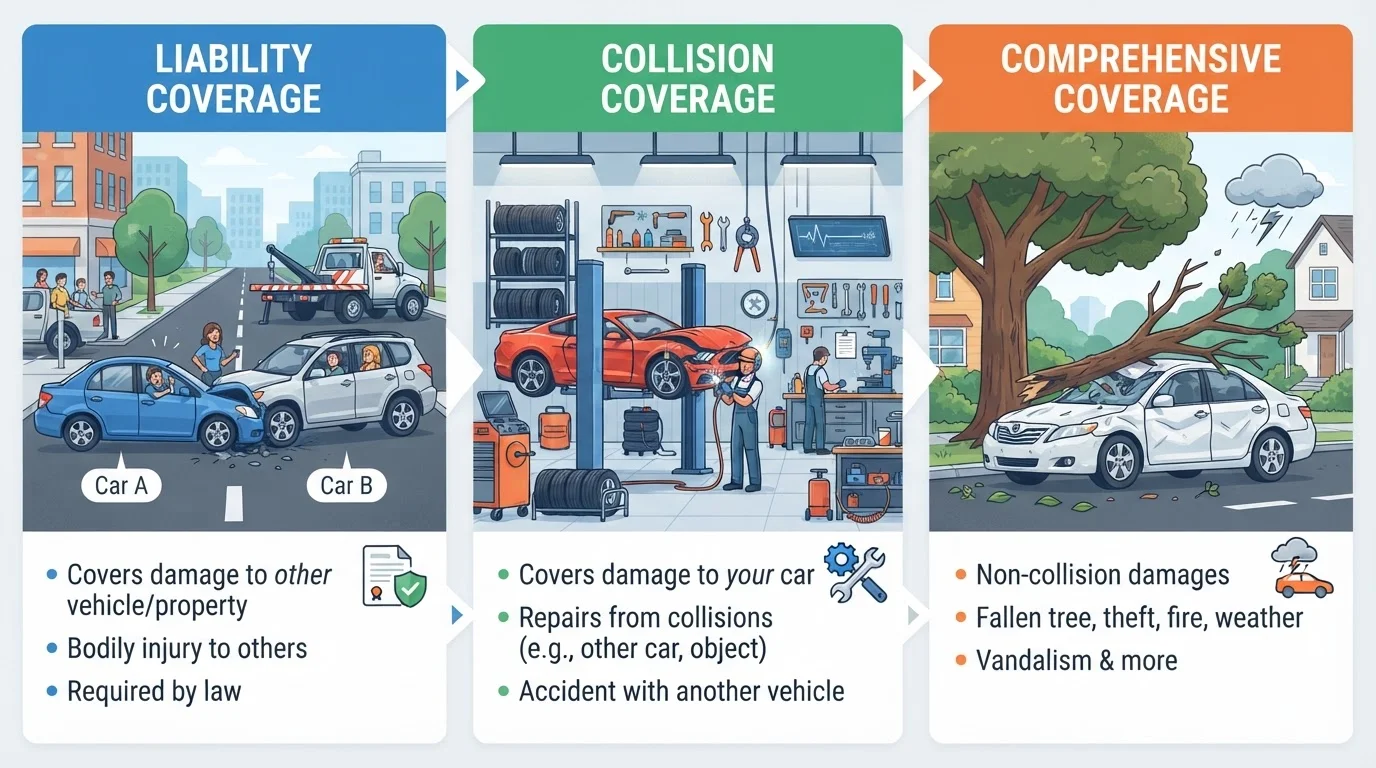
Most auto insurance policies are built on three foundational coverage types: liability, collision, and comprehensive. Each one covers a different category of risk - from damage you cause others, to damage to your own vehicle from a crash or from events outside your control.
These three coverages are distinct policy components with separate limits and, for collision and comprehensive, separate deductibles. Insurers and state regulators treat them independently.
Liability Coverage: Protection for Others, Required by Most States
Liability is the foundational layer of any auto insurance policy, and in nearly every state it is legally required. When you are at fault in an accident, liability coverage pays for two things: bodily injury to other people (medical expenses, lost wages, legal costs if you are sued) and property damage to their vehicle or other property.
Policies express liability limits in a three-number format - for example, 25/50/25 - representing thousands of dollars for per-person injury, per-accident injury, and property damage. State minimums are often relatively low, and many drivers choose higher limits to protect against costly lawsuits. For a broader grounding in how your entire policy fits together, see Auto Insurance Decoded.
Liability does not pay for your own medical bills or vehicle damage - that requires separate coverages.
Check Your Liability Limits Carefully
State minimum liability limits are often far lower than the real cost of a serious accident. Medical bills from a multi-person injury accident can quickly exceed a 25/50 limit. Many insurance professionals suggest considering higher limits - such as 100/300 - to reduce personal financial exposure.
Collision Coverage: Repairs After a Crash
Collision coverage pays to repair or replace your vehicle after it is damaged in a collision with another car, a guardrail, a telephone pole, or any other object. It applies whether you are at fault or not, making it especially valuable in single-vehicle accidents where no other party's liability coverage would apply.
You choose a deductible when you purchase collision - common amounts range from $250 to $1,000 or more. A higher deductible lowers your premium but increases what you pay out of pocket at claim time. Lenders and leasing companies typically require collision coverage for financed or leased vehicles.
~13%
Estimated share of U.S. drivers uninsured
The Insurance Research Council has estimated that roughly one in eight drivers on U.S. roads carries no auto insurance, underscoring why liability-only protection leaves gaps.
$3,750+
Average collision claim payment (industry estimates)
Industry data from sources including the Insurance Information Institute indicate average collision claim payments have risen steadily, reflecting higher repair costs for modern vehicles.
For a detailed comparison of how collision and comprehensive differ in real-world scenarios, Collision vs. Comprehensive Coverage walks through exactly when each one applies.
Comprehensive Coverage: Events Beyond the Road
Comprehensive coverage handles vehicle losses that have nothing to do with a collision. Common covered events include theft, vandalism, fire, hail, flooding, falling trees or objects, and striking an animal. Like collision, it carries a deductible of your choosing and is typically optional unless a lender requires it.
The coverage pays up to the actual cash value (ACV) of your vehicle - what your car is worth at the time of the loss, not what you paid for it. If a vehicle is deemed a total loss, the insurer pays ACV minus your deductible.
Understanding your auto insurance terminology - including actual cash value, deductible, and exclusions - helps you read your policy accurately and avoid surprises at claim time.
How the Three Coverages Work Together
These three coverages are complementary, not interchangeable. Liability protects other people from your mistakes; collision and comprehensive protect your own vehicle from different categories of damage. Together, they form what the industry informally calls full coverage - though that term has no fixed legal definition.
Drivers who carry only the state-required liability minimum are exposed to significant out-of-pocket risk if their own car is damaged or totaled. State minimums vs. full coverage is a critical distinction worth understanding before deciding how much protection to carry.
Gap Insurance and Financed Vehicles
If you owe more on your car loan than the vehicle's current actual cash value, a total-loss payout from collision or comprehensive may not cover what you owe the lender. Gap insurance is a separate optional product designed to cover that difference. Ask your lender or insurer whether it applies to your situation.
One common gap even a full liability-collision-comprehensive policy leaves open: damage caused by an uninsured or underinsured driver. Uninsured and underinsured motorist coverage is a separate add-on that addresses that specific risk.
This article provides general educational information about auto insurance coverage types and is not personalized insurance or legal advice. Coverage terms, limits, exclusions, and requirements vary by insurer and by state. Always read your policy documents carefully and consult a licensed insurance agent for guidance specific to your situation.