

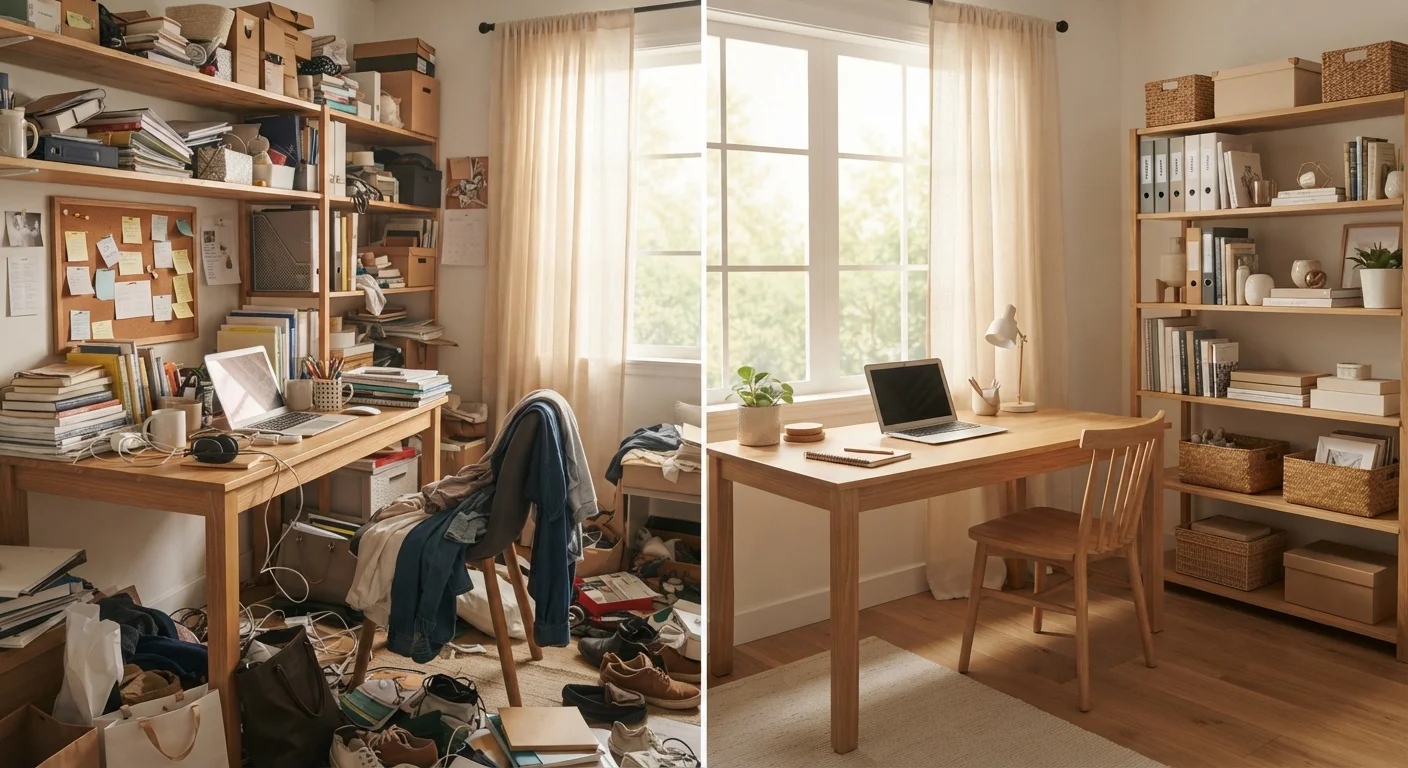
Key Takeaways
Option A
Decluttering
The essential first step - deciding what stays and what goes.
Best for: Anyone with too much stuff who needs to reduce volume before any system can work.
Option B
Organizing
The structural phase - giving everything a designated, logical home.
Best for: People with a manageable amount of possessions who need a reliable system to maintain order.
If your home feels chaotic and you're not sure where to start
Decluttering
Excess volume is the most common root cause of household chaos. Reducing what you own makes every subsequent step - including organizing - dramatically easier.
If you own a manageable amount of stuff but can never find anything
Organizing
When volume isn't the problem, the issue is a missing system. Organizing gives every item a designated place so locating things becomes automatic.
If you've organized repeatedly but your home keeps reverting to mess
Decluttering
A space that keeps falling back into disorder usually contains more items than its systems can sustain. Removing the excess is what makes the organization stick.
If you've recently moved or downsized to a smaller space
Decluttering
New spaces often have different storage capacity. Decluttering to match the new footprint before setting up any systems saves significant time and prevents overfilling.
Two Words, Two Very Different Jobs
Decluttering and organizing are frequently used as if they mean the same thing. They do not - and confusing them is one of the most common reasons home organization efforts fail within weeks of a big clean-out.
Decluttering is about reducing volume. It is the process of deciding which items are worth keeping and which should be donated, discarded, sold, or recycled. Decluttering does not require any bins, labels, or drawer dividers. It requires decisions.
Organizing is about creating structure. It is the process of assigning a logical, accessible home to every item that remains after decluttering. Organizing is where storage solutions, categories, and systems come in.
Think of it this way: decluttering determines what you keep; organizing determines where and how you keep it. One is editorial, the other is architectural. Both matter - but only in the right order.
If you want to build solid organizational habits from the ground up, this introduction to home organization covers the core principles and mindset shifts that make lasting systems achievable.
| Criterion | Decluttering | Organizing |
|---|---|---|
| Core question | Should I keep this? | Where does this belong? |
| Primary goal | Reduce item volume | Create structure for kept items |
| Tools required | Bags, boxes for removal | Bins, labels, storage systems |
| When to do it | Always first | After decluttering is complete |
| Common mistake | Skipping it and going straight to organizing | Organizing before reducing volume |
| Result when done well | Fewer items, easier decisions | Systems that are easy to maintain |
Why Sequence Is Everything
The single most consequential rule in home organization is this: always declutter before you organize. When that sequence gets reversed, two predictable problems emerge.
First, you end up building systems around items you don't actually need. Buying a set of labeled bins to store clothes that no longer fit - or gadgets you haven't used in three years - is effort and money spent on preserving clutter, not solving it.
Second, the systems you create will be too large for real use. A well-designed organizing system is calibrated to the actual volume of items it must hold. When that volume is inflated by things that shouldn't be there, the system becomes unwieldy and hard to maintain.
1 in 4
US households with a clutter problem in the garage
According to the US Department of Energy, roughly one in four American households with a two-car garage cannot fit any cars inside due to stored belongings.
40%
Of housework attributed to excess clutter
Research cited by the National Soap and Detergent Association has suggested that eliminating clutter could reduce housework by roughly 40 percent in the average home.
The practical result is that the space looks better briefly, then slides back into disorder - not because the organizing was poor, but because there was too much stuff for any system to sustain. Why organized spaces fall back into chaos explores this pattern in more depth and offers concrete ways to break it.
Decluttering first makes organizing faster, cheaper, and far more durable. When you only organize what you've decided to keep, every system you build is right-sized from the start.
Common Misconceptions Worth Clearing Up
Several persistent beliefs make it harder for people to approach decluttering and organizing clearly. Two of the most common deserve direct attention.
A Note on Sentimental Items
Sentimental belongings are often the hardest category to declutter, and that's normal. It helps to separate the memory from the object - keeping a photo of an item is one way to honor the memory without retaining the physical item. There is no universally correct number of sentimental items to keep; the practical question is whether what you have fits comfortably in your space without displacing things you use regularly.
Misconception 1: Clutter means you're disorganized. Clutter is primarily a volume problem, not a character flaw or organizational failure. A person can have excellent organizing instincts and still accumulate too much - especially in a culture that makes acquiring things easier than letting them go. The fix is reduction, not a better labeling system.
Misconception 2: More storage solves clutter. Adding shelves or bins without decluttering first simply gives clutter more room to expand. Storage is a tool for organizing what you've decided to keep - it cannot substitute for the decision-making that decluttering requires.
A useful decision-making framework for the decluttering phase is the keep-donate-discard method, which helps you sort more quickly and with less second-guessing. And if you want to separate genuinely helpful organizing advice from widely repeated myths, these common organization myths are worth reviewing before you invest in any new system.
How to Apply Both in Practice
A straightforward room-by-room approach works well for most households. Start with one manageable area - a single drawer, a closet, or a pantry shelf - rather than attempting the whole home at once.
Phase 1 - Declutter: Remove everything from the space. Sort items into keep, donate, discard, or relocate piles. Be honest about frequency of use, condition, and whether the item serves a current need. Items that are broken, duplicated, or untouched for a year or more are strong candidates for removal.
Phase 2 - Organize: Once only kept items remain, group them by category and use pattern. Items used daily belong at the most accessible points. Less-used items can occupy harder-to-reach areas. Assign a specific home to each category, and make sure anyone else using the space knows the system.
If your household includes multiple people with different habits, organizing a home with multiple people offers practical guidance on building systems that work for everyone.
The goal isn't a perfectly curated home - it's a functional one that you can actually maintain without constant effort.