

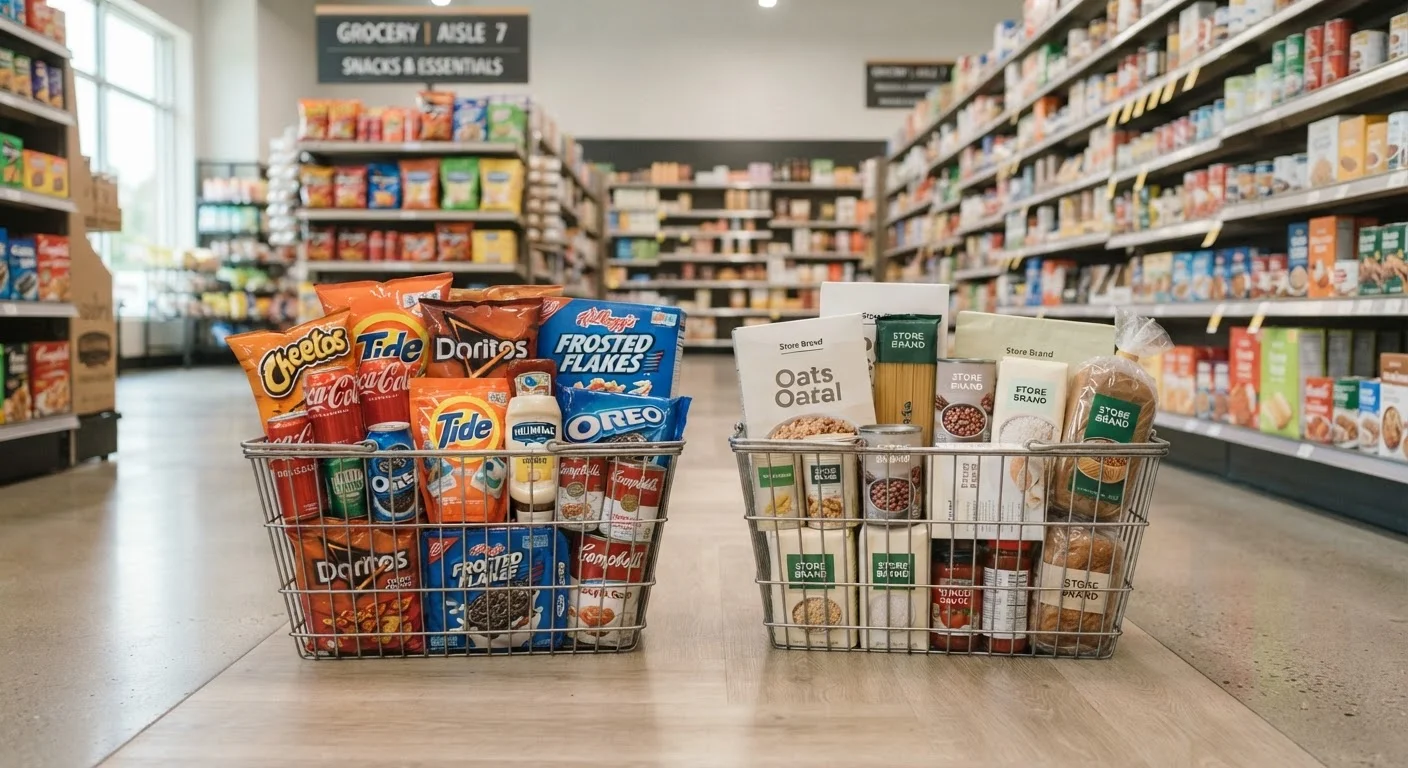
Key Takeaways
Option A
Name Brands
The established, heavily marketed choice with consistent identity.
Best for: Shoppers who prioritize specific formulations, proven track records, or category-specific performance where manufacturing differences are meaningful.
Option B
Store Brands (Private Label)
The cost-conscious alternative that often shares origins with name brands.
Best for: Shoppers looking to stretch their budget on everyday staples where ingredient lists and outcomes are genuinely comparable.
If you want to cut grocery costs without sacrificing meal quality
Store Brands (Private Label)
For pantry staples like canned tomatoes, dried pasta, flour, and frozen vegetables, store-brand and name-brand products are nutritionally and functionally near-identical. The savings add up meaningfully over time.
If you're buying over-the-counter medication
Store Brands (Private Label)
Generic OTC drugs must meet the same FDA active-ingredient standards as name brands. Comparing the active ingredient and dosage on both labels will confirm equivalence in most cases.
If you're purchasing specialty skin care or hair care products
Name Brands
In cosmetics and personal care, proprietary formulations, delivery systems, and ingredient concentrations can differ significantly. The quality gap here is more likely to be real and noticeable.
If you're stocking up on household cleaning supplies
Store Brands (Private Label)
Most general-purpose cleaners share the same core chemistry. Store-brand versions typically perform comparably on everyday surfaces at a lower cost per unit.
If you're buying durable tools or appliances
Name Brands
With durable goods, build quality, warranty support, and replacement part availability can vary considerably. Established brands in these categories tend to have more accountable supply chains.
Why the Price Gap Exists in the First Place
Name-brand products carry costs that go well beyond manufacturing. Companies invest heavily in national advertising campaigns, retail shelf placement fees (called slotting fees), and brand-building over many years. These expenses are embedded in the retail price you pay. Store brands - also called private-label products - skip most of that overhead. Retailers contract with manufacturers to produce goods under their own label, often at lower volume commitments, and pass much of the savings to the consumer.
What often surprises shoppers: some store-brand products are produced by the same manufacturers as their name-brand counterparts. This is particularly common in categories like canned goods, over-the-counter medications, and basic dairy products. The product inside may be identical; the packaging and price are not. That said, this is not a universal rule - some name brands produce exclusively for their own label, and independent store-brand manufacturers do exist.
Understanding this origin story helps calibrate your expectations. The question isn't always "is store brand worse?" It's "in which category does the difference actually matter to me?" For a deeper look at how marketing language shapes perceived value, see how promotional framing works.
Categories Where Store Brands Hold Up Well
Certain product categories are genuinely low-risk for switching to a store brand. These are areas where regulatory standards, commodity ingredients, or straightforward chemistry make meaningful quality differences unlikely.
| Criterion | Name Brands | Store Brands |
|---|---|---|
| Price | Higher (includes marketing costs) | Lower (reduced overhead) |
| OTC Medications | FDA-regulated active ingredients | Same FDA-regulated standards |
| Pantry Staples | Consistent, well-known quality | Comparable quality, fewer frills |
| Specialty Skin Care | Proprietary formulation depth | May vary in concentration |
| Durable Goods | Established warranty & support | Variable build quality |
| Frozen Vegetables | Reliable, standardized | Nutritionally comparable |
| Cleaning Supplies | Well-tested formulas | Adequate for general tasks |
- Pantry staples: All-purpose flour, granulated sugar, table salt, dried beans, and canned tomatoes are commodity products. USDA and FDA standards regulate their composition, and the "name" on the label adds little functional value.
- OTC medications: In the U.S., the FDA requires generic over-the-counter drugs to contain the same active ingredient at the same dosage as their branded equivalents. A store-brand acetaminophen with 500 mg of active ingredient is not a lesser product - it meets identical standards.
- Frozen vegetables: Snap-frozen produce often retains nutrients comparably to or better than fresh options that have spent days in transit. The store-brand version of frozen peas or corn is typically indistinguishable in nutritional value and taste.
- Basic cleaning products: Dish soap, all-purpose spray cleaners, and laundry detergents rely on well-understood chemistry. While formulations vary, store-brand versions of general cleaners perform adequately for everyday household tasks in most consumer tests.
For strategies on when buying more of these staples makes sense - and when it quietly backfires - see bulk buying tradeoffs.
Where the Quality Gap Is Genuinely Real
Not every category rewards the switch. There are areas where proprietary formulation, material quality, or technical performance create real, tangible differences - and where paying more may be the better long-term decision.
Infant Formula and Medical Diets: Consult First
For products like infant formula, medical nutrition supplements, or specialty items used by people with diagnosed health conditions, quality and formulation differences can carry real health implications. Always consult a qualified healthcare professional before substituting store-brand versions in these contexts. This article provides general consumer information, not medical advice.
- Specialty skin care and cosmetics: Active ingredient concentrations, stabilizers, and delivery systems vary considerably between brands in this space. A store-brand retinol serum may contain the ingredient but at a concentration or pH level that affects how well it performs. Ingredient lists help, but they don't tell you everything about formulation quality.
- Durable goods and tools: With items like power tools, small kitchen appliances, or hardware, build quality, motor grade, and long-term reliability can differ in ways that affect how long the product lasts. Warranty terms and the availability of replacement parts also tend to favor established name brands with accountable supply chains.
- Infant formula: This is a category where regulatory standards are strict and scrutiny is appropriate. While all formulas sold in the U.S. must meet FDA nutritional requirements, consult your pediatrician before switching brands, especially for infants with specific dietary needs.
- Some food categories with distinctive formulations: Specialty cheeses, hot sauces with proprietary recipes, and cultured dairy products sometimes have genuine taste and texture differences tied to the brand's specific process - though this is worth testing for yourself rather than assuming.
When you can't physically examine a product before purchase, evaluating these distinctions gets harder. The guide to assessing quality without handling a product offers practical signals to look for in listings and labels.
How to Make the Call: A Practical Framework
The most useful habit is comparison shopping at the ingredient or specification level - not the label level. Here's a simple approach:
~25%
Average price difference, store vs. name brand
Consumer research organizations have consistently found store-brand products priced roughly 20-30% lower than their name-brand counterparts across grocery categories.
80%+
OTC generics meeting identical active-ingredient standards
The U.S. FDA requires all OTC generic drugs to contain the same active ingredients at the same dosage and strength as their branded equivalents.
1 in 5
Shoppers who switched to store brands and stayed
Multiple grocery industry surveys have found that a significant share of consumers who tried store brands during periods of price pressure continued buying them afterward.
- Read the active or primary ingredients first. For food and OTC products, if the first few ingredients and any active components match, the functional gap is likely small.
- Check for relevant certifications. USDA Organic, NSF International, or UL certification on a store-brand product signals that independent standards have been met, not just the retailer's internal quality claim.
- Assess durability expectations. If you're buying something meant to last years, weigh the total cost of ownership - a cheaper item replaced twice is often more expensive than a pricier one purchased once.
- Try before committing at scale. For consumables, buy one unit of the store brand and compare it directly. Your own experience is the most reliable data point for preference-driven purchases like coffee, condiments, or personal care.
This category-by-category approach is a core part of shopping smarter as a everyday consumer. There's no universal answer - the goal is building a reliable mental map of where to save and where to invest.