

Key Takeaways
Smartwatch Sensors
Smartwatch sensors are small hardware components built into the watch that detect and measure physical signals from your body and environment. Each sensor converts a specific type of physical data - light, motion, electrical signals - into numbers the device can process and display. Together, they power the health tracking, navigation, and notification features you use every day.
Most smartwatches use sensor fusion - combining data from multiple sensors simultaneously - to produce more accurate measurements than any single sensor could achieve alone.
The Optical Heart Rate Sensor: Light as a Detector
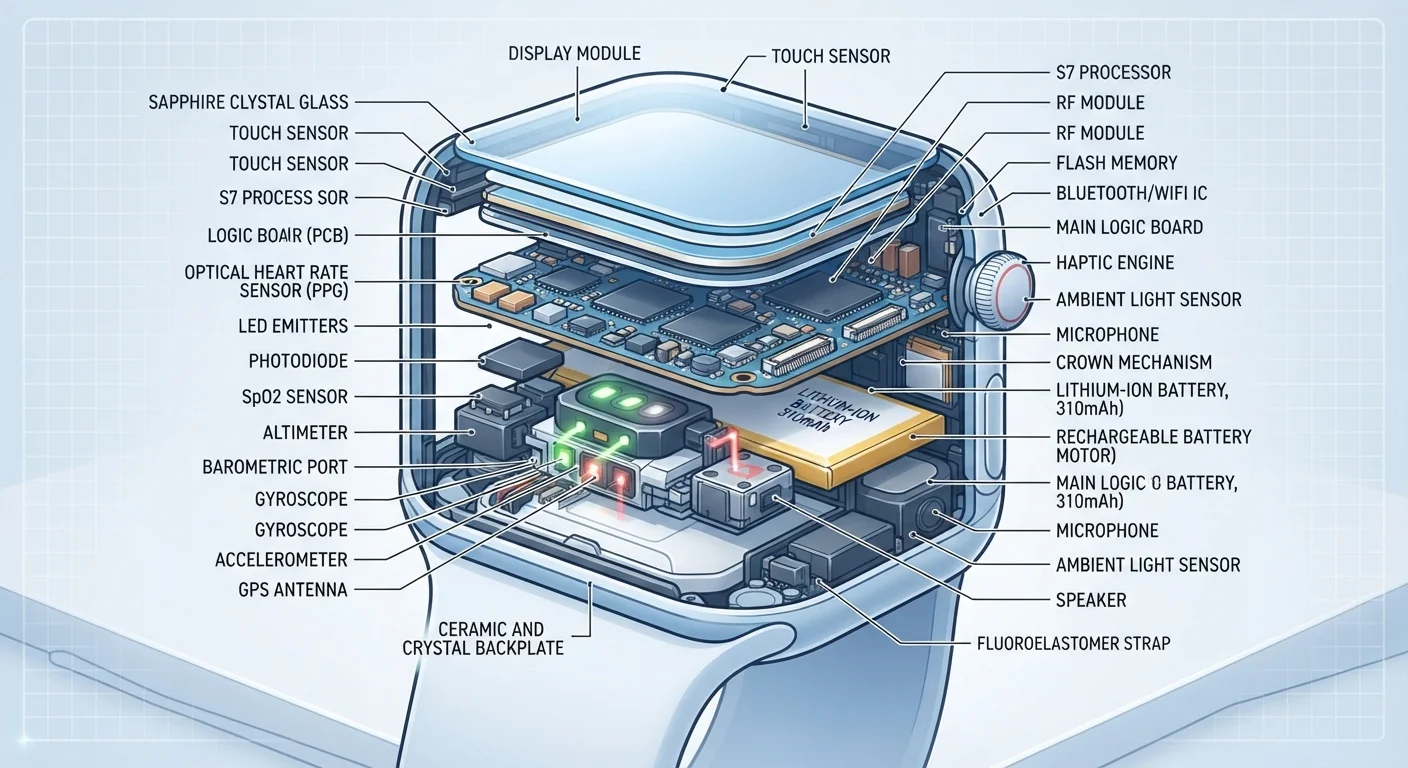
The most prominent sensor cluster on the back of any smartwatch is the optical heart rate monitor, technically called a PPG sensor. It works by shining green LED light into your skin and measuring how much light bounces back to a photodetector. Because blood absorbs green light differently depending on whether it is oxygenated and flowing, the sensor can detect tiny changes in blood volume with each heartbeat.
When your heart beats, a pulse of blood surges through the capillaries in your wrist. The PPG sensor picks up this rhythmic fluctuation in light absorption and translates it into a beats-per-minute reading. The accuracy depends heavily on how snugly the watch sits against your skin - a loose band allows ambient light to interfere with the signal.
For a deeper look at what those heart rate numbers actually mean during activity, see what your heart rate tells you during exercise.
±2-3 bpm
Typical optical heart rate margin of error at rest
Research published in peer-reviewed journals has found consumer PPG sensors generally fall within 2-3 bpm of ECG reference measurements under resting and moderate exercise conditions.
3 axes
Dimensions measured by a 3-axis accelerometer
All modern smartwatch accelerometers capture movement data along three perpendicular axes simultaneously to reconstruct wrist motion in full three-dimensional space.
~10-15 hrs
Typical GPS-active battery life in mainstream smartwatches
Most mid-range smartwatches report significantly reduced battery life when GPS is running continuously compared to standard watch mode, which can exceed multiple days.
Accelerometers and Gyroscopes: Making Sense of Movement
Nearly everything a smartwatch labels as "activity" passes through an accelerometer first. This sensor measures acceleration forces along three axes - forward/backward, side-to-side, and up/down - capturing the motion of your wrist in three dimensions. A gyroscope complements it by measuring rotational movement and orientation.
Raw accelerometer data is just a stream of numbers. The smartwatch's onboard software applies algorithms to interpret what those numbers mean: whether you are walking, running, cycling, or sitting still. Step counting, for instance, involves detecting the characteristic rhythmic oscillation pattern produced by a walking gait. Calorie estimates layer in additional assumptions about your body weight, age, and movement efficiency.
This is worth understanding because the numbers these sensors produce are estimates, not measurements. Common misreadings of fitness tracker data explores exactly how these estimates can mislead.
Get More Accurate Readings From Your Watch
Wear your smartwatch one finger-width above your wrist bone and snug enough that it does not slide freely. During high-intensity workouts, wrist-based optical sensors are more prone to motion artifact errors - a chest strap heart rate monitor paired via Bluetooth will generally provide more reliable data in those conditions.
SpO2, ECG, and the Emerging Sensor Layer
Newer smartwatches include sensors that would have seemed ambitious in medical devices a decade ago. The SpO2 sensor uses two wavelengths of light - red and infrared - to estimate how much oxygen your hemoglobin is carrying. Unlike the green LED used for heart rate, red and infrared light penetrate deeper into tissue, giving a broader picture of blood oxygen levels.
Some devices also include electrocardiogram (ECG) functionality. This works through electrodes embedded in the watch case and the digital crown or back plate. When you complete the circuit by placing a finger on the crown, the watch measures the small electrical signals your heart generates with each beat, producing a single-lead ECG trace.
It is important to understand the boundary here: these features are screening tools designed to flag potential anomalies, not clinical instruments. Any result that concerns you warrants a conversation with a qualified healthcare provider - not a self-diagnosis based on a wrist sensor.
Consumer Sensors vs. Medical Devices
Consumer smartwatch sensors operate under different regulatory standards than certified medical devices. SpO2 and ECG readings from a smartwatch can be useful for general awareness, but should not be used to make medical decisions. If you have a health condition requiring precise monitoring, consult a healthcare professional about clinically validated equipment.
GPS, Barometric Altimeter, and Environmental Sensors
Smartwatches with built-in GPS communicate with satellite constellations to calculate your position, speed, and route during outdoor activities. The GPS receiver draws considerably more power than other sensors, which is why most watches show a shortened battery estimate when GPS is active.
A barometric altimeter measures air pressure to estimate elevation change - useful for tracking floors climbed or altitude during hikes. Because air pressure also varies with weather, some watches use this sensor to generate basic weather trend forecasts.
Skin temperature sensors, now appearing in a growing number of models, detect small changes in wrist-surface temperature across the day. These readings are used to support cycle tracking features and general wellness monitoring, though the data represents skin temperature rather than core body temperature, which introduces meaningful limitations.
Understanding the trade-offs of sensor-laden wearables versus other connected devices - like smart displays - can help clarify what you actually need. See the real trade-offs of owning a smart display for a comparable breakdown on another popular category.
“The sensors in consumer wearables have improved dramatically, but the gap between what a device can detect and what it can reliably interpret remains significant. Algorithms are doing a great deal of the work - and algorithms have assumptions baked in.”
— Dr. Meredith Loh, Biomedical engineering researcher specializing in wearable sensor systems