

Key Takeaways
Option A
End-to-End Encryption (E2EE)
The gold standard for message privacy.
Best for: Anyone who wants their messages readable only by the sender and recipient - with no access granted to the service provider.
Option B
Standard (Transport) Encryption
The common baseline that protects data in transit.
Best for: Scenarios where protecting data from outside attackers is the priority, and service-provider access is acceptable or necessary.
If you're sharing sensitive personal, financial, or medical information
End-to-End Encryption (E2EE)
E2EE ensures only your intended recipient can read the message. No server in between holds a decryptable copy.
If you're using a business platform that requires message auditing or compliance logging
Standard (Transport) Encryption
Organizations often need to access message records for legal or compliance reasons, which E2EE prevents by design.
If you want the strongest available protection against surveillance or data breaches
End-to-End Encryption (E2EE)
Even if a provider's servers are breached, E2EE messages remain unreadable to attackers without the recipient's private key.
If you primarily need protection against network-level eavesdropping (e.g., on public Wi-Fi)
Standard (Transport) Encryption
Transport encryption is specifically designed to secure data as it moves across networks, which covers most common interception risks.
How Each Type of Encryption Actually Works
When you send a message through almost any modern app, some form of encryption is involved. But encryption is not a single thing - the architecture behind it determines who can actually read your messages and under what circumstances.
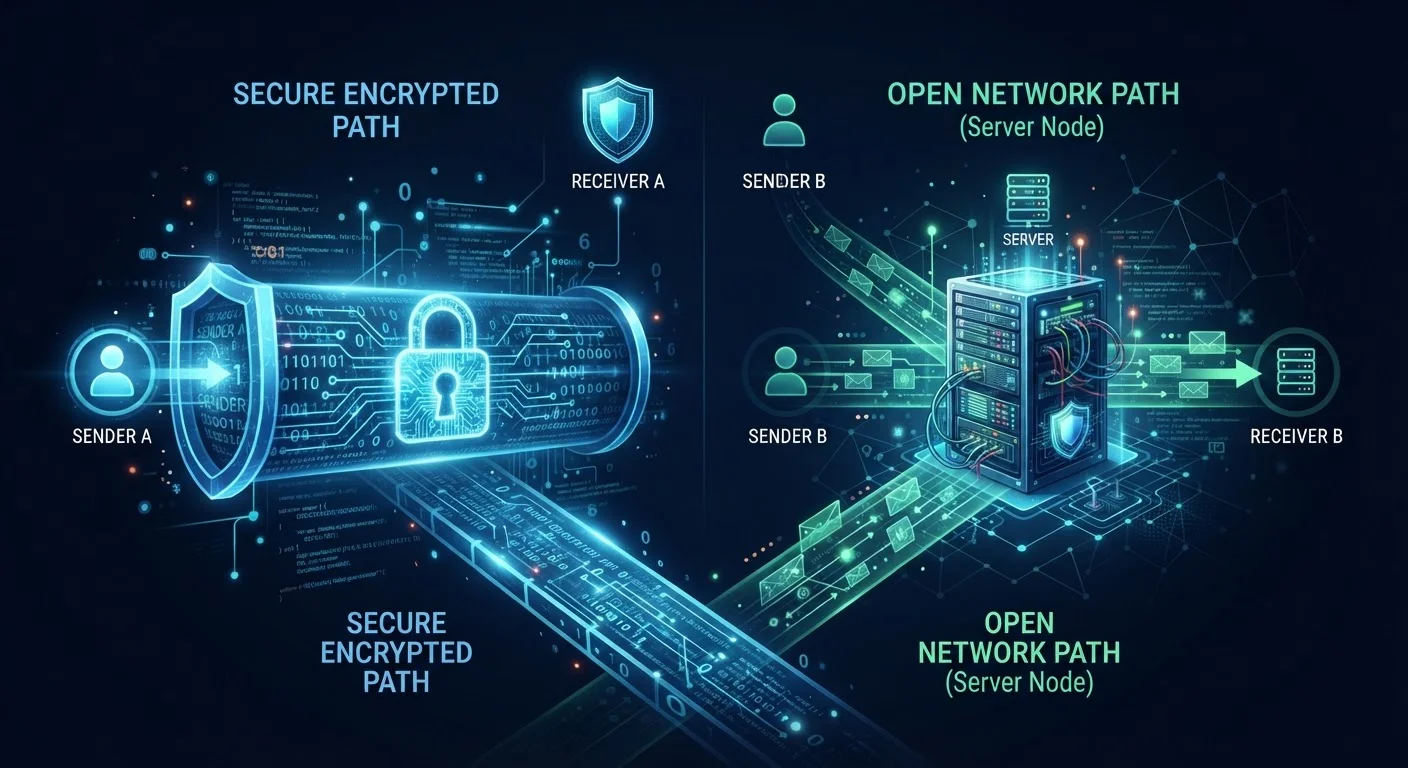
Standard encryption, also called transport-layer encryption (often implemented via TLS - Transport Layer Security), scrambles your message as it travels between your device and the app's servers. Once the message arrives at those servers, the provider can decrypt and read it. The message may then be re-encrypted for delivery to the recipient. This means the service company holds the keys, at least momentarily.
End-to-end encryption (E2EE) works differently. Messages are encrypted on your device using your recipient's public key, and can only be decrypted by the recipient's private key - which never leaves their device. The provider's servers relay the encrypted data but cannot read it. In a properly implemented E2EE system, even the company operating the service cannot access the message content.
| Criterion | End-to-End Encryption | Standard (Transport) Encryption |
|---|---|---|
| Who holds decryption keys | Only sender and recipient | Service provider (server-side) |
| Provider can read messages | No | Yes, in principle |
| Protection against server breaches | Strong - ciphertext only exposed | Depends on server-side security |
| Legal data requests | Provider cannot produce readable content | Provider can comply with readable records |
| Common usage | Signal, iMessage, WhatsApp (default) | Most standard email, many workplace tools |
| Metadata protection | Often limited or excluded | Often limited or excluded |
| Protects against network eavesdropping | Yes | Yes |
Understanding this distinction matters beyond technical curiosity. It affects what a company can hand over to law enforcement, what gets exposed in a data breach, and what an app provider can potentially do with your conversations. For a broader look at how apps access and handle your data, see our breakdown of app permissions.
Where Standard Encryption Falls Short - and Where It's Sufficient
Transport encryption is not a flaw - it's a widely deployed, meaningful protection. When you log into your bank's website or send an email through a major provider, TLS is doing important work: preventing someone on the same public Wi-Fi network from intercepting your data mid-transmission. That's a real threat, and transport encryption addresses it well.
The limitation emerges when your concern shifts from outside attackers on the network to the service provider itself. With standard encryption, the provider holds decryption capability. This means:
- The company can read message content for moderation, advertising analysis, or other purposes (subject to their privacy policy).
- If served a valid legal order, the company can produce readable message records.
- A server-side breach could expose decrypted messages if not properly secured.
Metadata Is Often Not Encrypted
Even robust E2EE implementations typically do not protect metadata - the record of who communicated with whom, at what time, and how frequently. This information can reveal patterns even when message content remains private. If metadata privacy is a concern, look specifically for services that describe minimizing or not retaining metadata, and understand that no messaging service can guarantee complete metadata anonymity.
This doesn't make standard encryption irresponsible - most email services, many workplace chat tools, and numerous consumer apps operate this way. It becomes a concern when the content is sensitive and you want to minimize who can access it.
For context on other settings that quietly affect your privacy, review the settings most people never change.
What to Look For Before You Send Sensitive Messages
Identifying whether an app uses E2EE requires a little research, but it's not difficult. Here's what to check:
~2 billion
Users on at least one E2EE-enabled platform
WhatsApp alone reported over 2 billion active users as of recent figures, all using E2EE by default for messages - illustrating how widely the technology has been deployed even if users aren't always aware of it.
Server-side
Where standard encryption can be decrypted
With transport-layer encryption, the service provider's infrastructure is the point at which messages can be read - meaning a breach of those servers, or a legal order to the company, can surface readable content.
- Read the app's security or privacy documentation. Reputable services explicitly state whether E2EE is available and whether it applies to all message types or only some (for example, some apps encrypt one-on-one chats but not group conversations or media files).
- Look for opt-in requirements. Some platforms offer E2EE as a non-default feature that users must manually enable. A setting or mode labeled "secret chat" or "private conversation" is a common signal.
- Understand what's excluded. Even in apps with strong E2EE, metadata - who you messaged, when, and how often - may not be encrypted or may be retained by the provider.
Being deliberate about which apps carry which kinds of conversations is a practical privacy habit. Sensitive financial or medical discussions warrant a different level of scrutiny than casual exchanges. This connects to broader digital literacy concepts covered in our beginner's guide to online privacy.
Encryption is one layer of security - pairing it with strong authentication practices adds another. See how two-factor authentication methods differ in strength for a related step worth taking.