

| Most common source of clutter | Items without a designated home (General consensus among professional organizers) |
| Dead space opportunity | Up to 30% of room volume often unused (General estimate; varies by room layout) |
| Benefit of labeling storage | Faster retrieval and easier maintenance (Common finding in home organization research) |
| Modular vs. fixed shelving | Modular can be reconfigured; fixed cannot |
| First step in any organization project | Declutter before you organize (Standard professional organizer guidance) |
Why Storage Vocabulary Matters
When you start researching home organization - whether you're reading advice articles, browsing storage solutions, or talking to a professional organizer - you'll quickly run into a consistent set of terms. Knowing what these words actually mean helps you evaluate ideas more clearly, communicate better with others in your household, and make smarter decisions about how to use your space.
This glossary covers the most commonly used storage and organization terms you're likely to encounter. Think of it as a quick-reference companion as you work through your home. For a room-by-room application of these concepts, see our complete home walkthrough.
Dead Space
Unused volume in a room that isn't currently serving a storage or functional purpose - such as the area above cabinets, under a staircase, or between furniture and the ceiling. Identifying and activating dead space is one of the fastest ways to increase storage capacity without renovation.
Zone
A defined area within a room designated for a specific category of items - for example, a 'mail zone' near the entryway or a 'cleaning supplies zone' under the sink. Zones reduce clutter by giving every item a consistent, predictable home.
Modular Shelving
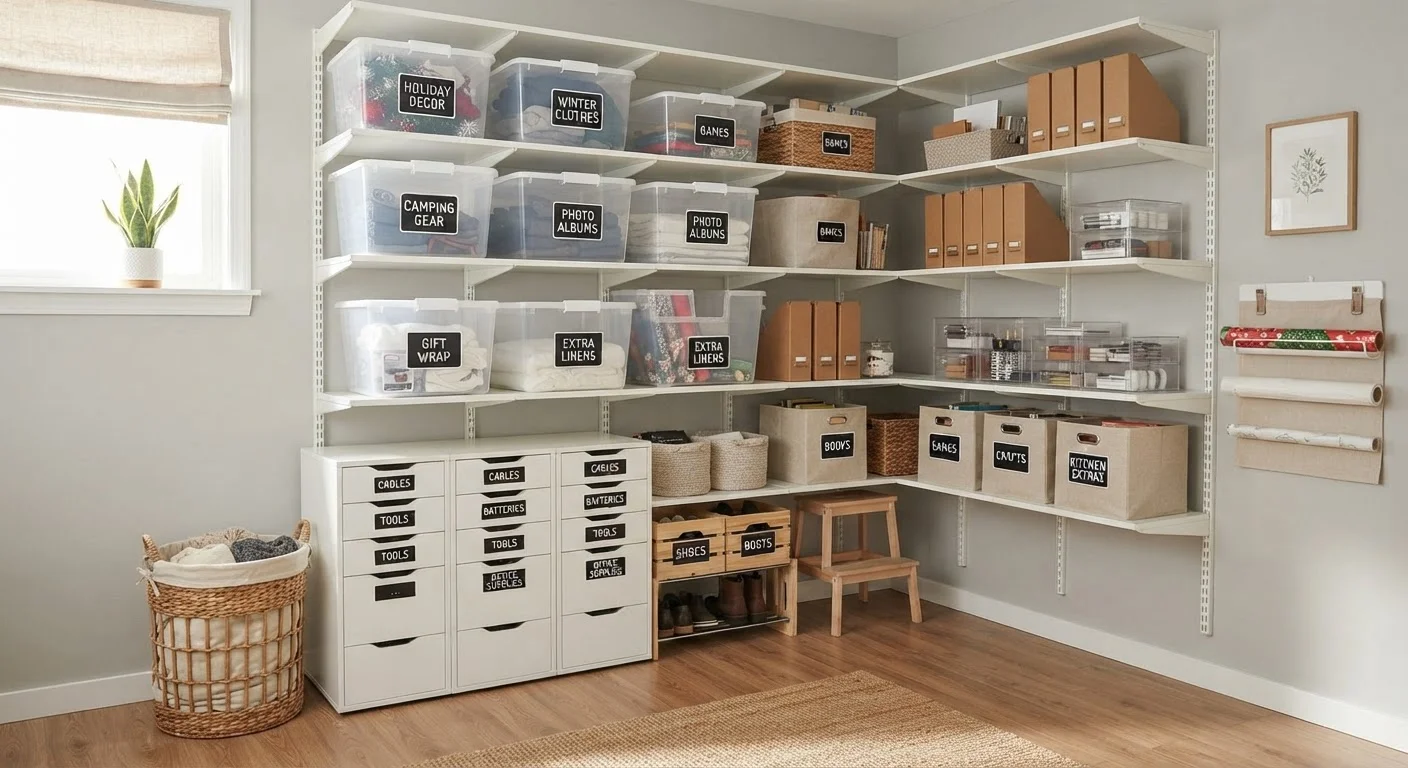
A shelving system made of interchangeable components that can be reconfigured as your needs change. Modular units are valued for their flexibility, since you can add, remove, or rearrange sections without replacing the entire system.
Decanting
The practice of transferring items - especially pantry goods or bathroom products - from their original packaging into uniform containers. Decanting creates a more consistent visual appearance and often makes better use of shelf space.
Vertical Storage
Using wall height - not just floor area - for storage. Wall-mounted shelves, tall bookcases, and hanging organizers are common examples. Vertical storage is especially valuable in small spaces where floor space is limited.
Rotation System
A method of cycling items - particularly in pantries or seasonal storage - so that older items are used before newer ones. Rotation systems reduce waste and keep stored goods accessible and current.
Multi-Functional Furniture
Furniture designed to serve more than one purpose, such as an ottoman with interior storage or a bed frame with built-in drawers. Multi-functional pieces are a key strategy in small-space organization.
Decluttering
The process of removing items from a space that are no longer needed, used, or valued. Decluttering is typically the first step in any organization project, since organizing items you don't need simply moves the problem around.
Active Storage
Storage for items you use frequently - within easy reach and quickly accessible. Active storage is typically located at eye level or in prime cabinet and drawer space.
Deep Storage
Storage for items used infrequently - such as seasonal decorations, archived documents, or rarely used equipment. Deep storage can occupy harder-to-reach areas like high shelves, attic space, or the back of a closet.
Capsule System
An organizational approach that limits a category of items to a defined, manageable quantity - most commonly applied to wardrobes. The goal is to own fewer, more intentional items rather than managing large volumes of things.
Drawer Dividers
Inserts or separators placed inside drawers to create distinct sections for different items. Dividers prevent items from mixing together and make it easier to locate things quickly.
Core Concepts in Home Storage
Beyond individual terms, home organization relies on a handful of foundational principles that tie everything together. Understanding how these ideas work in practice - not just in theory - makes it much easier to build systems that last.
| Most common source of clutter | Items without a designated home (General consensus among professional organizers) |
| Dead space opportunity | Up to 30% of room volume often unused (General estimate; varies by room layout) |
| Benefit of labeling storage | Faster retrieval and easier maintenance (Common finding in home organization research) |
| Modular vs. fixed shelving | Modular can be reconfigured; fixed cannot |
| First step in any organization project | Declutter before you organize (Standard professional organizer guidance) |
Zones are perhaps the most powerful concept in home organization. When every category of item has a designated home, you eliminate the decision fatigue that leads to clutter. A zone doesn't have to be a whole room - it can be a single shelf, a drawer, or a basket. What matters is that everyone in the household knows where things belong.
Dead space is one of the most overlooked opportunities in a home. The area above kitchen cabinets, the gap between a dresser and the ceiling, or the space under a bed frame are all examples of dead space that can be activated with the right storage approach. Our guide on vertical storage and rotation principles explains how professionals put this space to work.
If you share your home with others, terminology like shared zones and personal zones becomes especially relevant. Defining boundaries clearly can reduce conflict and make systems more sustainable. See our article on organizing shared spaces for practical guidance.
Organization Terms Aren't Universal
Different sources - books, professional organizers, and online communities - may use these terms slightly differently. For example, some people use 'zone' and 'station' interchangeably, while others make a distinction. When you're working with a specific system or guide, check how that source defines its own terminology to avoid confusion.
Applying These Terms in Small Spaces
For anyone living in an apartment or compact home, storage vocabulary takes on even more importance. Terms like modular shelving, multi-functional furniture, and vertical storage aren't just jargon - they represent genuine strategies for making a small footprint feel livable and organized.
When every square foot counts, the difference between dead space and active storage can be significant. Installing a pegboard in a small kitchen, using stackable bins in a narrow closet, or choosing a bed frame with built-in drawers are all ways to convert unused volume into functional storage. Our small-space organization strategies article explores these approaches in depth.
One final note: organization terminology sometimes gets borrowed across contexts. If you've been researching storage broadly, you may have encountered terms related to digital file management - that's a different subject entirely. For a clear explanation of how online file storage works, see our piece on cloud storage explained. The two domains use some of the same words but describe very different things.
Armed with this vocabulary, you're better prepared to read, plan, and talk about home organization with confidence - and to spot the difference between genuinely useful advice and common organization myths.